
By John Dobberstein, Editor
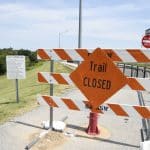
The city has awarded a bid to replace the failing Liberty Trail retaining wall that resulted in closure of a section of the popular community asset.
Cherokee Pride Construction was awarded the project with a bid of $861,000. Funds for the project will be taken from 2018 GO Bond revenues.
The city expects the contractor to be on site late this summer and the project timeline is 120 days.
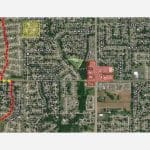
The project will replace the failing wall on the trail between Aspen Avenue and Elm Place on the north side of the Creek Turnpike. The wall is 807 feet long and ranges from 2 to 8 feet in height.
Charlie Bright, the city’s director of Engineering & Construction, said a buildup of hydrostatic pressure led to the wall failing.
Last year, the city’s Engineering & Construction Department said it would have to spend at least $500,000 to fix the problems, and the money was authorized by the City Council. Due to the complexity of the design and construction of the improvements the final cost ended up higher.
“It is frustrating and I feel the frustration of the citizens. It wasn’t a project that was planned and our wall failed and it’s not something that is budgeted,” Bright told the City Council recently.
The project will include demolition of the existing gravity wall and trail and replacing it with a reinforced concrete retaining wall and foundation that will also function as the trail. The project will also improve drainage and connecting to the existing drainage system, Bright said.
Bright said the city will be coordinating with the Oklahoma Turnpike Authority for traffic control measures on the Creek Turnpike, along with the entrance ramp to the highway on Elm Place, which will be in place through the project’s duration. The trail and wall belong to the city, but they sit on Oklahoma Turnpike Authority property.
An evaluation by McGuire Civil Engineering Services a year ago found the segmental block retaining wall — which was constructed in 2003 — had “visible signs of distress and potential failure,” with a “pronounced bulge” that developed in one section where blocks dislodged from the earth fill behind them.
The engineering firm’s evaluation raised concerns that the structure wasn’t constructed to proper standards. The wall is located downslope from the turnpike about 35 feet away, with no evident drainage infrastructure to intercept runoff from the road, the city said.
Runoff appears to flow directly toward the wall, which doesn’t have any weep holes or gravel backfill zone, “which are standard design requirements,” the engineer firm said.



Leave a Reply