
By John Dobberstein, Editor
A phased plan that would allow Broken Arrow to secure a second water source from the Grand River to meet population projections and safeguard its supplies has been approved by city leaders.
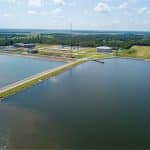
Consulting firm HDR recently presented several options to the City Council for increasing water supplies to Broken Arrow, and a multi-part approach was chosen that involves anticipated cooperation with the Oklahoma Ordnance Works Authority (OOWA), which operates the Mid-America Industrial Park.
HDR’s identified options included expanding the capabilities of drawing more water from the Verdigris River; accessing Grand River water through OOWA using gravity or pumped supplies; or purchasing water from the Grand River supply through a Grand River Dam Authority partnership with a pumped supply.
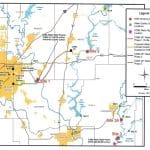
HDR engineers investigated the potential of utilizing a city-owned 36-inch waterline that stretches 21 miles from OOWA in Mayes County to the Verdigris water plant. The waterline, built in 1982, hasn’t been used since a new water treatment plant came online in 2014.
The city says its assessments and water sampling from the pipeline show it can still be used to bring “raw” (untreated) water in from the Grand River. HDR and city staff recommended a combination approach with a gravity supply design to utilize the existing waterline with an eventual pump station to bring Grand River water from OOWA.
HDR’s recommended course of action includes six phases and is estimated to cost between $165 million to $188 million to complete. The city’s environmental project engineer, Emily Rowland, said Broken Arrow has over $23 million dollars in its capital improvement plan to invest in the water project.
The first step in the Grand River Water Supply Study is to negotiate a memorandum of understanding with OOWA to purchase, ultimately, up to 25 million gallons per day (GPD) of water, and an infrastructure use agreement. Assistant City Manager Kenneth Schwab said Broken Arrow could have a new water source producing as much as 12.6 million GPD in 4-6 years.
Averting problems
Currently, the city’s only water source is the Verdigris River, and the city’s Verdigris River Water Treatment Plant can treat up to 30 million GPD. Additionally, the city can tie into the Tulsa Metropolitan Utility Authority waterlines in two locations as necessary to add to the water supply. But those sources are only meant to be a supplement.
HDR says its projections show Broken Arrow would require as much as 34 million GPD during the peak days of summer by 2040, and up to 46 million MGD by 2070.
Schwab notes the Verdigris River is home to the Tulsa Port of Catoosa, the furthest inland port in the U.S., and if there were a spill or major contamination it could cause problems for Broken Arrow’s water supply. Broken Arrow City Councilor Johnnie Parks said there was a scare many years ago when the city had to shut down its water plant due to a potentially hazardous waste leak from a barge at the Port of Catoosa.
Additionally, taste and smell concerns with the treated Verdigris River water have been a nagging problem. Algae blooms on Adams Creek, which connects to the river, have often been the culprit. “It’s not a fact of if you’re going to have them, it’s when,” Schwab said.
Broken Arrow historically has faced many challenges matching its water supply with growth. Its first pumphouse for a water supply was built in 1909 at Ray Harral Spring with the city’s first revenue bond. That served as Broken Arrow’s primary water supply until 1967, when a new water treatment plant was built to handle 4 million GPD.
Broken Arrow’s population began to increase rapidly after that, and the plant was expanded to handle 10 million GPD. In 1982 the city entered into a water purchase agreement with OOWA for 31 years to purchase treated water. In 2014 a new water plant opened that could process 20 million GPD, and the OOWA pipeline was shuttered.
Looking at the future
In 2015 HDR completed a long-term water study for the city and identified a need for additional water in the future. That same year, Broken Arrow received a letter from the Oklahoma Water Resources Board that said Broken Arrow’s water rights were going to be reviewed for curtailment.
HDR reached out to OWRB recently to discuss the letter issued but was unresolved. Earlier this year, Broken Arrow’s permit at Tenkiller Ferry Lake was released by Broken Arrow due to the distance between Tenkiller and the city, and because there were no storage rights.
A third permit Broken Arrow applied for at the Verdigris River was still pending from OWRB, and it was discovered OWRB was not actively seeking to curtail Broken Arrow’s existing water rights.
HDR also contacted the Grand River Dam Authority, which confirmed that they had water available. In fact, only half of the water available was being used and over 90 million gallons of water was available per day.
Kristi Shaw, senior water resources engineer with HDR, said there were two water rights on the Verdigris River, which combined allow Broken Arrow to use 24.3 million GPD, with a maximum diversion of 30 million GPD.
Schwab said building a new treatment plant would be necessary to execute the long-term water plan, but how soon that would be needed depends on how fast Broken Arrow’s population grows – with current projections showing between 2035 to 2040.

Leave a Reply