By John Dobberstein, Editor
Broken Arrow’s continued population increases are putting pressure on the city’s utilities, including its water supply systems.
To better gauge Broken Arrow’s water system needs into the future, the City Council authorized spending nearly $600,000 to hire consultant to develop a master plan.
The last such plan for the city’s water system was drawn up in 2013, and the city has added more than 15,000 residents since. While growth has occurred throughout Broken Arrow, much of the current residential development pressure is happening on the city’s south and east sides.
Garver LLC was selected by the City Council to update the 2013 plan. The firm’s chief duties will be to evaluate the Broken Arrow Municipal Authority’s current water system to identify issues that need to be addressed and outline improvements needed to meet future water needs.
The master plan report will evaluate the Verdigris River Water Treatment Plant, water distribution lines, booster pump stations and water storage tanks in the city. The report will give recommendations for capital improvements projects to improve the distribution system over time as continued growth occurs.
The study is a new project being funded with Oklahoma Water Resources Board loan money left over from previously completed projects.
The city has already been grappling with water supply needs and taking steps to address them.
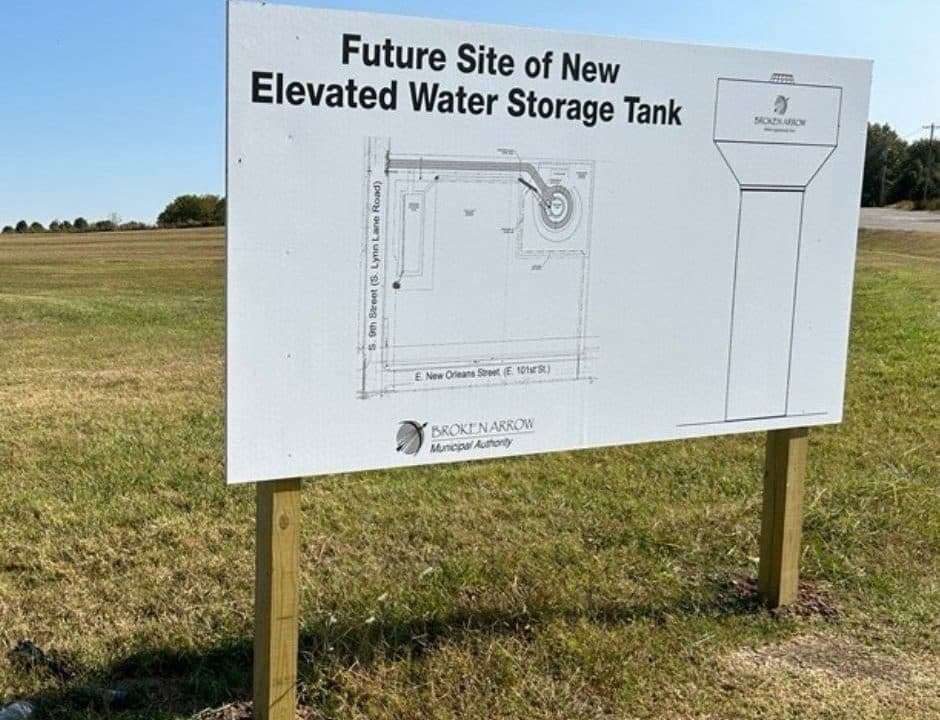
Construction is expected to begin in early 2025 on an elevated water storage tank on 11.5 acres at the northeast corner of New Orleans Street and Lynn Lane Road, costing $10.7 million. It will be the Broken Arrow’s seventh elevated water storage tank, bringing the city’s internal storage capacity to 13.5 million gallons.
Engineering and Construction Director Charlie Bright said elevated water storage tanks are typically large enough to contain a 24-hour water supply for the area served by the tank.
The project consists of constructing a 2.5-million-gallon elevated storage tank, two waterline connections, an overflow pipe, a detention pond, site grading, an access road, a fence-enclosed tank site, paving, and electrical work, including Federal Aviation Administration lighting.
Water lines and an on-site water transmission main are also included in the project. The contract time for the project is 480 calendar days.
The city is also taking steps to ensure adequate water supply into the future by building a connection to the Grand River so it will serve as another source of water for Broken Arrow.
Funds from the Safe Drinking Water (SDW) Loan Program will provide $870,000 to design the Oklahoma Ordinance Works Authority Grand River Line Connection, which, when the entire project is completed, will give the city an additional water source besides the Verdigris River.
The Safe Drinking Water project list also includes a 2-million-gallon (MG) water tank restoration project at Tiger Hill, estimated to cost $1.6 million to design and construct.
Those two projects are part of a $20.2 million loan agreement with the OWRB that will finance parts of 21 water utility improvement projects in the city. The low-interest loan will be used for Fiscal Year 2025 Capital Improvement Projects as part of the Clean Water and Safe Drinking Water Programs.
The program will finance 11 Clean Water projects to improve the sanitary sewer system, totaling just over $12 million.
Two of the projects to be funded through the loan are at the Haikey Creek Wastewater Treatment Plant (HCWWTP). The plant services Broken Arrow and Tulsa and is a part of the Regional Metropolitan Utility Authority (RMUA). The RMUA is a joint venture between the cities of Tulsa, Broken Arrow, Jenks, Bixby, and Owasso. Its purpose is to maintain, operate, and provide water supply, wastewater, and pollution control facilities.
One of the HCWWTP projects is a composting facility, that is expected to cost more than $30 million to build. The United States Department of Agriculture (USDA) awarded $9 million toward the project, which leaves approximately $24 million to be split evenly between the City of Tulsa and the BAMA. The plan is to fund the project with OWRB loans over the next 2 years.


Leave a Reply