By John Dobberstein, Editor
and Angel Ford, Contributing Writer
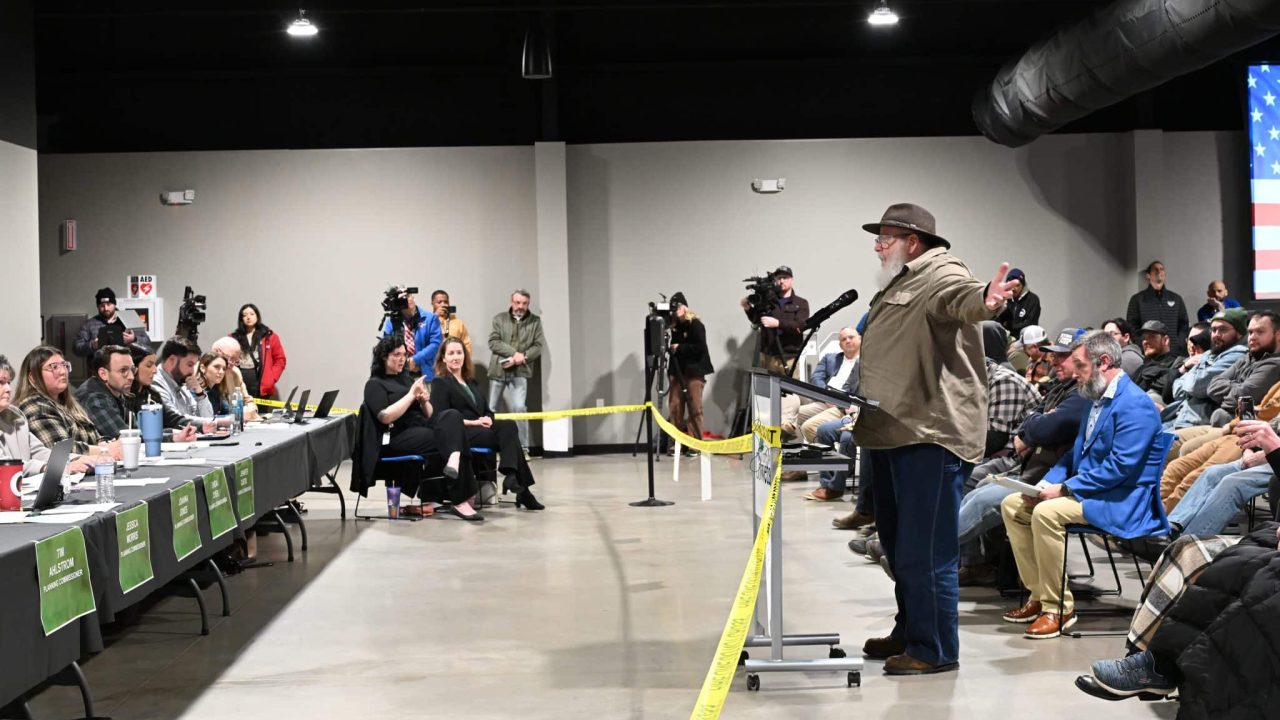
COWETA — The Coweta Planning Commission, cordoned off from the public by yellow tape, voted to recommend denial of a firm’s request for rezoning more than 200 acres of agricultural land for a 400-megawatt data center in the city.
Opposition to the project has been very vocal since it was announced last fall, and that continued during the tense meeting at the Indian Capital Training Center as the Planning Commission voted 4-1 in favor of the motion to deny.
Planning Commission members Tim Ahlstrom, Jessica Morris, Joanna Jones and Jennifer Curtis voted for a motion to deny the rezoning, while member Linda Dyer voted against the motion. The matter is now expected to go before the Coweta City Council in early February.
It was a raucous atmosphere at times as nearly 300 people came to the Indian Capital Training Center for the public hearing, most of them adamantly opposed to the project.
Laura Harvey, the development director overseeing the project, said Project Atlas, “will just be the backbone of the Internet. This is basically what governments and hospitals rely on to store their data safely here in the U.S.
“Every small business uses the data center through QuickBooks, transactions, things like Etsy. Every time you check cattle market prices, or weather radar, you’re using a data center. Your Facebook and social media, how we all connect and share information, and Facebook does not just exist on your phone. It’s rather your phone is a window into a data center.
“This project is not crypto mining. There’s no solar generation, wind generation, nuclear or gas. It is not operated by a foreign country.”
Harvey said Beale would be contributing about $195 million over 25 years to the Coweta community, including $500,000 towards a water system master plan and $3 million for water infrastructure upgrades, along with $1 million for local parks.
Over 25 years, the estimated power will generate $50 million in franchise fees for the city, or $1 million to $2 million per year. Coweta Public School would receive about $17 million over that same period. “That is enough to give every teacher a $10,000 pay increase and still have $6 million left over for athletic facilities, sports programs and more,” Harvey said.
The data center’s buildout would employ hundreds of workers over several years and there would be more long-term jobs in technology at the center. More contractors will be needed to support the facility, she added, including utilizing local businesses for security, HVAC, plumbing, electrical and building maintenance.
“The more jobs that are in Coweta, the more people are spending. Rather than people going to work in other communities, people are coming to Coweta and spending their dollars.”
Harvey said there would not be any impact to electric bills due Beale Infrastructure’s contract with PSO stating the firm is “100% responsible” for upgrades the data center is triggering to local infrastructure. The data center would tap directly into a high-power transmission line already on the site.
However, many residents were not convinced about having a data center in their city, despite Beale’s assurances, citing various concerns about hidden costs, noise, lack of water capacity, environmental impacts and more.
“Passing this would be the height of uninformed irresponsibility. This is not compatible for Coweta,” said Allen Prather of Coweta, who lives 300 feet from the proposed project and has been one of the most vocal opponents of the project. “People do not move to Coweta to be next to a data center. We want you to go away.”
Some speakers who were in favor of the data center, including those working in the unionized trades who said, jobs were important to their colleagues — though some of them were nearly shouted down by others in the audience, telling one of the speakers to “go home.”


Leave a Reply