By John Dobberstein, Editor
After more than 90 minutes of discussion between Broken Arrow residents, developers and the City Council, a zoning change was approved Tuesday for a 38-acre housing project on the city’s south side.
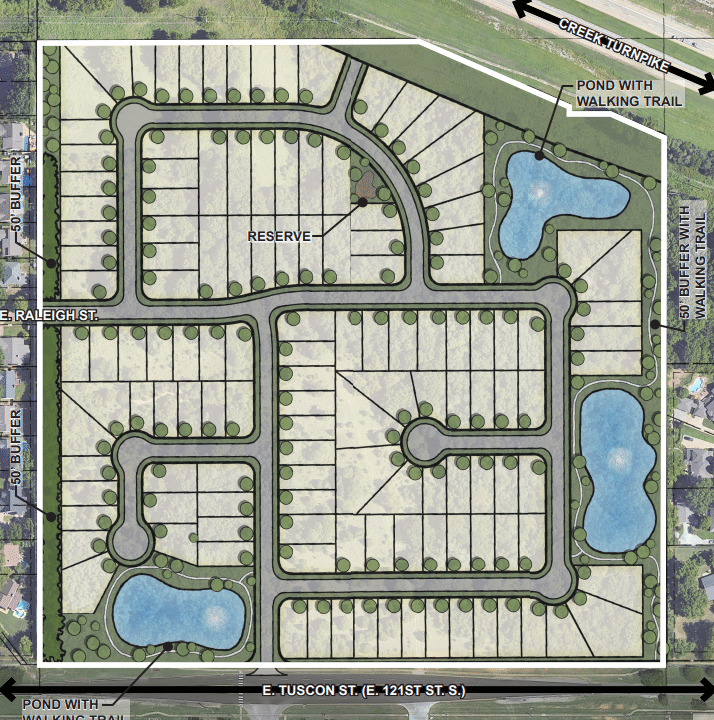
Spring Creek Crossing, to be located along Tucson Street between Lynn Lane and Aspen avenues and across from two schools, is estimated to include a maximum of 145 units of single-family housing.
It’s the third iteration of this development, after two proposals in the last year were rejected by the Broken Arrow Planning Commission.
More than 100 residents signed a petition expressing opposition to the rezoning request and preliminary development plans, saying the smaller nature of the lots — estimated to be about 5,000 square feet — and homes didn’t fit the character of surrounding neighborhoods.
During various meetings over the past year with the proposal, residents have levied typical concerns about a new housing project, including school overcrowding, noise and traffic, and declining property values. Spring Creek Elementary and Childers Middle schools are across the street from the parcel.
In the end, the City Council voted 3-2 to approve the zoning change, although it will be a Planned Unit Development (PUD) that gives the city some leverage to negotiate design requirements.
Voting against the request were Mayor and Ward 1 Councilwoman Debra Wimpee and Ward 2 City Councilman Justin Green. The development is in Green’s ward. Ward 3 Councilwoman Christi Gillespie, Ward 4 Councilwoman Lisa Ford and At-Large Councilman Johnnie Parks voted “yes.”
A lot appeared to be riding on the vote due to the neighborhood opposition, some frustration expressed by well-known housing developer Rausch Coleman, and a City Council grappling with urban sprawl and difficult land-use decisions.
Just a few weeks ago, Point Consulting told the City Council and Planning Commission that Broken Arrow was the largest city in the state without a housing authority, and there isn’t enough affordable or “attainable” housing in the city.
The city is also wrapping up a sweeping revision of its suite of zoning ordinances with the help of a citizen’s advisory committee, which is sure to play a major part in land-use decisions in the coming years. Broken Arrow also has a comprehensive plan that serves as a guide on how the city of 120,000 people will develop.
Gillespie shared that her 24-year-old daughter was able to move into a house because they bought a fixer-upper and they helped her renovate and purchase it.
“If that hadn’t happened, she would still be in an apartment,” Gillespie said, noting the city’s demographics are much older than they were 30 or 40 years ago. “We’re very emotional about our properties and homes are our biggest investment. We’re going to have to make a decision where some people won’t be happy.”
Kyle Richison, division president for Rausch Coleman Homes who lives in Broken Arrow, told councilors his firm has committed to building a traffic light at Third Street and Tucson to help alleviate traffic issues during school days. He said the size of the project has been reduced to 145 units and the company confirmed that 15% of the property would be set aside as green space. He said the request before the Council is a land-use question and typically the “emotional” aspects of a project are not part of a rezoning request.
“We want to understand, before investing our time and money, if a project fits within the city’s comprehensive plan. And if the answer is ‘yes’ we should be able to move forward, as it’s just a land-use decision.”
Several residents commented again on the proposal Tuesday and clearly don’t agree with the city’s decision. “It doesn’t fit, it’s that simple,” said Dustin Fletcher of Broken Arrow, who argued the proposal didn’t fit the character of surrounding neighborhoods. “If you approve this you’re setting the tone throughout this entire community that anybody can come in and build any kind of development into any existing neighborhood.”
Assistant City Manager Ken Schwab said the Broken Arrow Public Schools told him Tuesday the district wasn’t in opposition.
Green said he lives near the project and he spent much time talking to neighbors about it. “I feel it’s our job to weigh what’s best for the city and our citizens, and it’s not the government’s job to tell individuals what they can or can’t do with their property,” he said. “Personally, I’ve had a lot of sleepless nights and I’ve spent a lot of time in prayer over this.”
Ford said the city’s comprehensive plan, even though it’s only an advisory document, deserves to be respected. She noted the Points Consulting housing survey and other surveys of residents show there is a need for more affordable housing in the city. “We have to do what’s best for the city and It sounds to me like the developer is bending over backwards to make it work with everybody around.”




Marta K. says
Bad plan no consideration for all of us that have been living for 26 or 30 years enjoying the calm life. In this area. The peopol who voted to be approved they do not care because they do not live around this crazy colony Lowe income housing they look like bee hive. And to add to the craziness the 2 school are over capacity.
ghstrdr4g says
I saw this in California and Arizona. It is all about the money.