By John Dobberstein, Editor
COWETA — Beale Infrastructure, the company proposing to build a large data center in Coweta, said Monday it is evaluating plans to use water from the Verdigris and Arkansas rivers and the site could consume as much as 400 megawatts of electricity annually.
A spokesperson for Beale told the Sentinel on Tuesday that many aspects of the data center, dubbed “Project Atlas,” are still being studied.
Here is updated information the company shared ahead of tonight’s open house for the project, slated for 5-7 p.m. at Coweta City Hall.
Electricity Demand: Project Atlas is intended to be a grid-connected customer of Public Service Co. of Oklahoma (PSO). Beale anticipates the site “could support up to 400 MW of capacity,” subject to additional studies. Any required infrastructure upgrades dedicated to Project Atlas would be funded by the project.
Water Use: The primary driver of water use is the cooling system to be used for the data center, and that is still under evaluation and will be selected, “based on the availability of water that can be reasonably and responsibly sourced,” the company said. “We are actively considering several water sourcing methods to safely and reliably serve the site without negatively impacting the community, the critical water resources, or our local ecosystems. We are also investigating projects to ensure that we support a stronger and more robust local water system.”
Beale said the decision for cooling system design is based on multiple factors, including resource evaluation, conservation impact, and community engagement. All those factors are considered to identify the cooling system which, “best balances community fit and impact to critical resources.”
Any industrial wastewater discharged from the facility will be treated in accordance with local and state standards, “to a point where it matches or exceeds the quality of the receiving water body,” Beale added. Currently, wastewater is planned to go to Coweta’s wastewater treatment plant. “If the opportunity existed,” Beale said, “industrial wastewater discharge could be used for irrigation for crops, golf courses or other grey water reuse purposes.”
Water Source: The company says domestic water needs for the buildings will be served by city of Coweta Water or Wagoner County Rural Water District #5. For industrial water, Beale is working with City of Coweta and RWD5 on studies to source water from the Verdigris and Arkansas Rivers.
“The outcomes of these studies will include available water supply as compared to future water demands and provide insights into how much water can be responsibly sourced, and which infrastructure upgrades would be necessary to supply water while protecting or enhancing level of service for existing residents,” Beale said in a statement. “Any water infrastructure upgrades required for the project would be fully funded by Beale.”
Noise Abatement: Beale said the facility will be designed to minimize the impact on surrounding properties through noise-abatement mitigation measures and strategic site planning. The zoning application proposes a maximum noise limit of 65 decibels, “which is comparable to many household appliances or a conversation at normal volume,” the company said.
“This is estimated to be the maximum sound emitted during an emergency. Operational levels will be well below this level.” Sound limitations in the project’s Planned Unit Development (PUD) are stricter than the standard zoning code requirements.
Tax Incentives: Beale said all operational data centers in Oklahoma have a negotiated tax agreement with the municipalities in which they operate that provide the community with, “a “steady stream of consistent, significant tax revenue which benefits local schools.
“For data center companies, they provide a way to fairly evaluate the taxable value of the property. Even with these agreements, it is estimated that the project will become one of the top 5 largest taxpayers in the area, and at full buildout could be the largest.”
The amount of money taxing jurisdictions could see hasn’t been determined yet, “and will ultimately be subject to evaluation by all taxing jurisdictions,” Beale added. “The tax agreement structure in Oklahoma allows for direct payments in lieu of tax to all taxing jurisdictions that would otherwise collect taxes.
“The monetary benefits are not limited to direct taxation, as our facility supports increasing wages, high quality trade jobs and will source from local suppliers further generating economic activity.”
Infrastructure Upgrades: Beale said it will be paying for the infrastructure upgrades needed for the land to be developed, including potential water treatment and distribution system expansions; electric grid capacity and reliability improvements, and transportation infrastructure improvements, as needed, to accommodate the project and avoid impacts to local traffic flow.
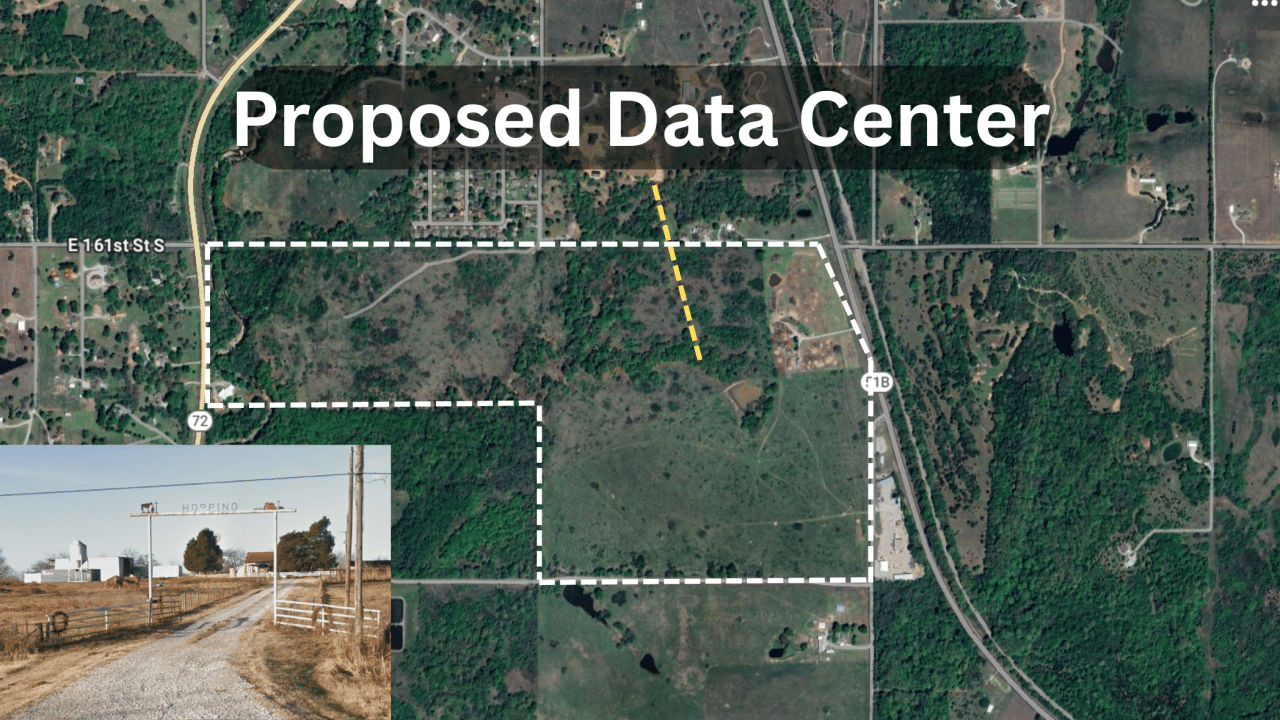
Subject to re-zoning approval of the property by the City Council and approval of the PUD, the data center would be located on about 200 acres along 161st Street South between Highway72 and Highway 51B. The property was annexed by the city earlier this month.
Many Residents Opposed to Project
To this point, most residents have expressed opposition to the development due to concerns about high water and electricity use, noise pollution and other issues. Coweta resident Kathy Foster has started a Change.org petition drive to stop the data center from being built, with 203 signatures gathered so far.
Foster says she lives close to the building site and she’s “deeply worried” about the impact the development could have on the area’s already strained resources and quality of life.
“Despite promises of economic benefits, the reality is that data centers come with a high environmental cost. One of my biggest concerns is the water usage for cooling these massive infrastructures. Coweta already struggles with water supply issues, and further strain could severely affect our community’s future access to clean water,” Foster says.
“Moreover, data centers are notorious for their substantial electricity consumption. The increased energy requirement could lead to outages or price hikes, impacting the affordability of living in our town.
“The development of this data center is not in harmony with the character and sustainability of our town. Instead of pushing forward with the construction of this data center, I urge local leaders to consider other viable, eco-friendly projects that can bring growth without sacrificing our resources and quality of life.”
Beale Infrastructure is a portfolio company of asset management company Blue Owl. Beale partners with the leading technology companies to develop data centers and infrastructure, “that supports national economic growth.” The end user of the data center hasn’t been disclosed.
The Coweta Industrial Development Authority sold 40 acres of property to Chicago-based Quartz Mountain Properties, a real estate developer, for $850,000 late last year. Quartz Mountain Properties is the same company that is developing the data center near Owasso.
County records also show a purchase agreement between property owners, Hopping Family Trust, and Quartz Mountain, which occurred in March.
Casteen said ownership of the properties will not transfer until all contingencies are met, including the ability to meet all infrastructure needs of the project. “If all needs are met, the developer will complete the purchase-sale agreements and will own all the property needed for the project,” she said.
Beale is the same company that proposed Project Clydesdale, a phased data center campus to be located near Owasso. The initial phase of that project, representing a $700 million investment, was approved by the Tulsa County Board of Commissioners on Sept. 30 after the county said the plan was in compliance with the county’s long-term land use plan.
The project was approved with tax incentives included. The Project Clydesdale campus will be located north of East 76th Street North, east of North Yale Avenue, south of East 86th Street North, and west of North Sheridan Road.



Leave a Reply