By John Dobberstein, Editor
The final proposition on Tuesday’s GO Bond Election has easily been the most controversial, spurring a passionate debate between advocates for youth sports programs and residents concerned about excessive taxes.
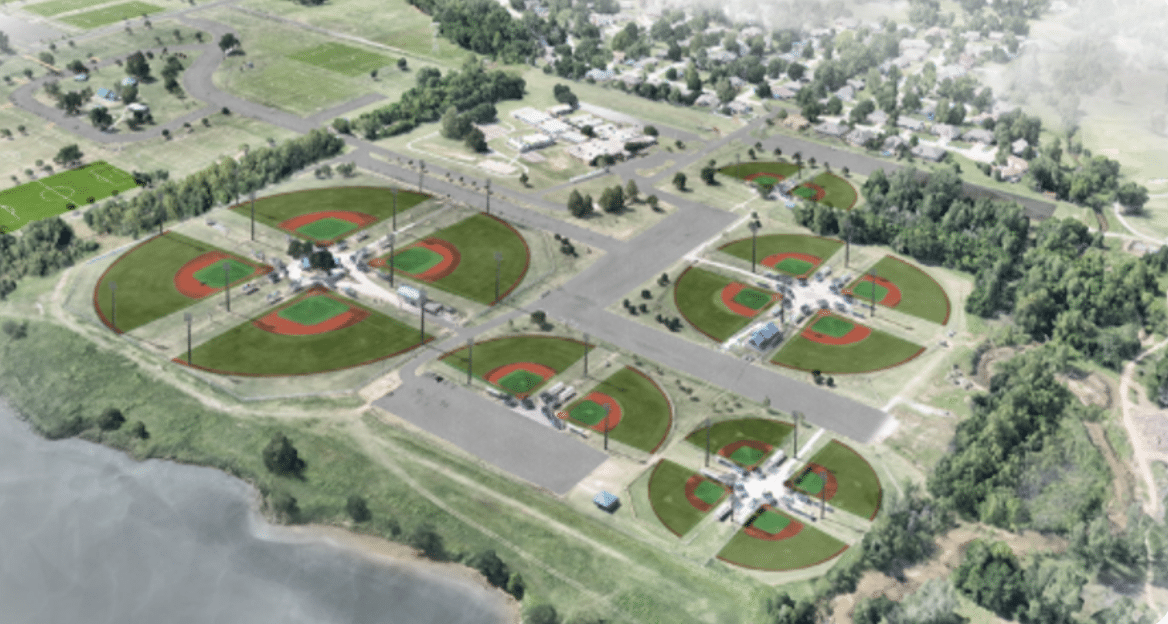
Proposition 8 calls for a sales tax increase of 0.5% to fund $53 million of improvements to sports facilities in Broken Arrow, including Arrowhead Softball Complex, Indian Springs Sports Complex and Nienhuis Park. If approved, the sales tax would start July 1 and expire on June 30, 2031.
The improvements would help benefit girls’ softball, youth baseball, youth soccer, youth football and lacrosse and adult softball.
More than half of the projects, $28 million worth, would be spent for substantial upgrades at the Indian Springs Sports Complex, including parking and lighting, turf conversions, and regrading and resodding of various fields for baseball, softball and soccer.
Another $13 million would be spent at the Arrowhead Sports Complex for resodding and turf conversions, lighting, parking and other improvements.
At Nienhaus Park most of the sales tax revenue would be spent on lighting upgrades, with other improvements slated for the entry plaza, drainage, restrooms and parking. Broken Arrow Youth Sports plays and practices at Nienhuis Park.
The Challenger Sports Complex would see $1.2 million in improvements with a new playground, parking lot expansion, batting cages and a bridge connection between Field 1 and Fields 2, 3 and 4,
‘We’ll All Benefit’
Advocates for the sales tax increase believe that through Broken Arrow Youth Sports, area kids in grades K-12 gain experience playing tackle football, flag football, cheerleading, pom, and lacrosse.
Broken Arrow Youth Football alone has about 400 children that participate, said Executive Director Chad Lott. Flag football has about 175 participants and in lacrosse the league expected to see 175 to 200 kids.
Lott says the benefits of sports, especially for kids, are “innumerable,” including socialization, leadership, and mentorship.
“One of the things that gets overlooked is that we’re all Broken Arrow people. We’re all here for our citizens and want to make it better,” Lott has said. “Having a sales tax specifically for youth sports is a positive way to go, because we’re the ones who bring in a lot of sales tax to the city, and book hotels for two- or three-night stays.
“All this contributes to the sales tax that will go back to our parks, whether it be for football, lacrosse, soccer, baseball, or softball. We’ll all benefit from it the same as all of our citizens, and that’s what creates a better environment for all of us.”
City officials also maintain that modern, multi-use turf fields can handle significantly more use with less downtime, and they reduce long-term maintenance costs such as watering, mowing and repairs.
They also believe projects such as the sports improvements drive economic activity, such as regional tournaments, traveling teams and visitors that spend money at local hotels, restaurants and shops.
Excessive taxation?
However, the sales tax increase has run into some vehement opposition, especially with some Wagoner County residents. Voters there recently had to approve a sales tax increase to pay for a pricey settlement against the county over a death in the county jail.
The group TEA’S (Taxed Enough Already) has lead vigorous formal opposition. TEA’S asserts that if the sales tax is approved it would place Broken Arrow in the top 1% of sales tax rates imposed on citizens, as the combined tax rate for Broken Arrow citizens living in Wagoner County would be 10.1%. About one-third of Broken Arrow’s residents live in Wagoner County.
“There is something very wrong with a double-digit sales tax rate. This is higher that most folks tithe to their churches,” said Brent Watson, a spokesperson for the group, adding the only major city in the U.S. with a higher rate would be Chicago at 10.25%.
For those living in Tulsa County, the combined rate would be 8.9%. This is far above the average U.S. sales tax rate of 7.53%, TEA’S asserts.
The city of Broken Arrow has pushed back on complaints the sales tax increase is punitive. City Manager Michael Spurgeon noted there were other cities that have sales tax rates of 10.1%, including parts of Oklahoma City and Bixby. TEA’S says that is true but only for small portions of those cities.
“For a family of four, this tax will cost over $1,760. This regressive, anti-family tax would cost approximately $441 per person over the 5-year life. Styling this as a ‘half-penny’ is disingenuous,” Watson said. “The city should live within its budget. Alternate funding, including raising user fees, redirecting other spending or obtaining private donations can be used to make improvements.”
Temporary or Not?
TEA’S, as well as many other residents, also argue the sales tax would, ultimately, become permanent, saying “there is no temporary tax.” The sales tax would have to go before voters if it was to be extended.
“Temporary taxes tend to be perpetuated as some other earmarked tax,” Watson says. “Also, all seven bond proposals are rollovers of previously imposed property taxes — just now designated for other usages. This is how temporary taxes become permanent taxes. No one can promise what city leaders will do 5 years from now.”
Said Spurgeon, “I’ve told people that I will not recommend to City Council, and the Council members have said that they will not extend this tax for any reason.”
Ward 2 Councilwoman Lisa Ford said no renewal of the sales tax increase would be needed because the work would be completed within that timeframe.
“It’s also important to understand this is a sales tax. Roughly 50% is paid by Broken Arrow residents, and the other 50% comes from visitors to our city,” Ford said. “That was intentional, so we can share the cost while making meaningful improvements.”



Leave a Reply