
By John Dobberstein, Editor
As police departments have faced retirements, recruitment challenges and in some cases increasing property crimes, some are utilizing modern surveillance technology to fill the gap and make response more efficient and effective.
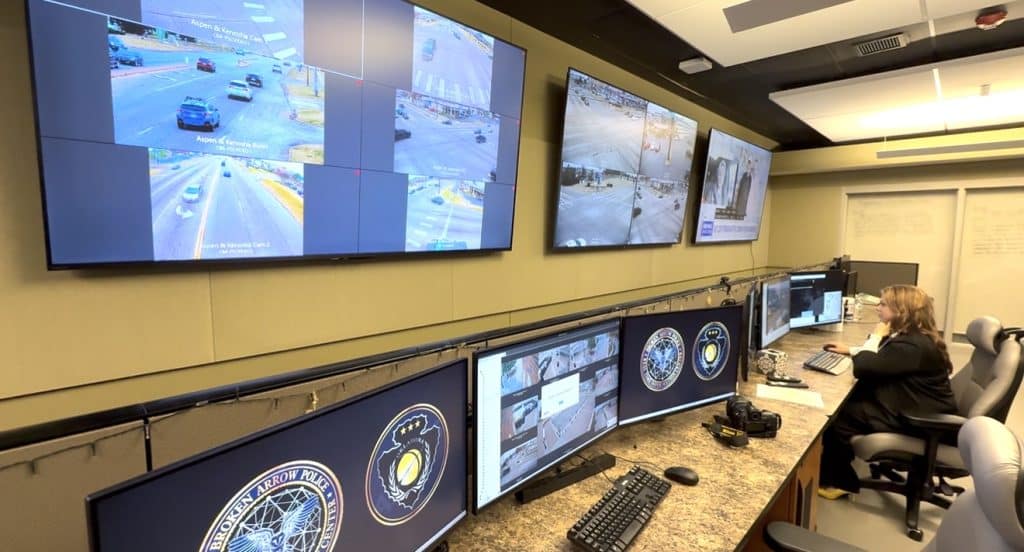
The Broken Arrow Police Department, facing many of the same staffing challenges as it patrols 63 square miles of territory, has moved in this direction with the unveiling of its Real Time Information Center. Located deep inside the city’s Public Safety Complex, the facility allows police and other emergency personnel to monitor Broken Arrow with multiple live video feeds and other data sources, enabling more efficient and effective response.
The RTIC gives police as much information as possible in the first 1-2 minutes of a call they’re responding to. It could be an officer involved in a struggle, an active shooter situation or any other situation where advance intelligence is helpful to protect the safety of police officers or the public.
The system will also aid police with preventative measures, such as when businesses are having problems with shoplifters or seeking to prevent theft.
“If they have any sort of description on the vehicle, I’m able to see where they’re going and help them find the suspects,” says Tricia Cook, the RTIC’s manager. “That’s been a big deal, especially getting close to the holidays.”
Hit-and-run accidents are another example of the camera network providing case information and potential follow-up. “We don’t catch all of them, but we are able to see a lot,” she says.
Police are also, in some cases, helping citizens with property damage. Recently, a camera at a public park was able to capture teenagers who were vandalizing and breaking into a nearby house. “We were able to use the park cameras to find out when it was happening,” which aided investigators, Cook notes.
BAPD also announced it will implement a “drone as first responder” program. This will allow drones to be flown to high-priority calls or fire emergencies to provide live video to the RTIC.
By the end of 2026, the city plans to have more camera asserts in the field per square mile than any other city in the region. The city is waiting for fiberoptic lines to be installed. City officials expect to have those capabilities fully ready in about 90 days, said Tener.
“I say that not to concern citizens, but to let them know when something happens in Broken Arrow we’re going to be able to solve a crime,” says BAPD Capt. Brandon Tener, the lead sworn officer over the RTIC.
Building a network
Since the operation center opened, the city has been gradually expanding its camera footprint, starting with the busy retail centers near Tiger Hill and Hillside Drive and heavily traveled intersections, especially on the north side, as well as at city-owned buildings, parks and hotels.
The city spent $80,000 with Windstream to provide internet services at key traffic signal intersections to enable camera feed integration with the RTIC, with the funds provided by the Broken Arrow Police Foundation through a grant from the Quik Trip Corp.
The city purchased Hanwha cameras for 30 major intersections at a cost of $271,000, which will benefit both BAPD and the Streets Department.
Broken Arrow currently has 4-way stationary cameras that record everything that happens at major intersections, as well as pan-tilt-zoom (PTZ) units for real-time use during incidents. Within the next couple of years the city also expects to have up to 50 license plate readers at major intersections.
Two high-profile assaults at Tulsa parks earlier this year pushed some municipalities evaluate safety measures in public spaces. Tener says the Broken Arrow doesn’t have great coverage at every city park but improvements are planned.
With some parks located on the city’s borders, suspected criminals can commit crimes and quickly flee across municipal lines and disappear into traffic.
Working with schools, QuikTrip
There will be key properties in Broken Arrow not covered by the RTIC camera system, but through third-party software police can request and gain access to other consenting networks.
One partner will be QuikTrip, which will allow officers to pick up activity at the company’s 8 Broken Arrow gas stations if city cameras don’t have coverage in a certain area. Tener says this is “huge” because each QuikTrip location has 45 to 50 cameras.
The city is also working with the Broken Arrow Public Schools, which 28 different buildings. RTIC cameras won’t be able to see inside a school, but if there is a call for service at a location that would grant police quick access. This is important to not only identify suspects but allow police to communicate with school security on access restrictions.
“When you look at a campus the size of Broken Arrow public schools, that’s going to be a massive game changer,” Tener says.
Hospitals and medical facilities, which have increasingly become targets of active shooters or other violent incidents, could also be potential partners.
Privacy Reigns
At a City Council meeting where the RTIC was being discussed, some expressed concerns about privacy rights and data security, with the potential for it to fall into the wrong hands or be misused. The city opted to store all its video data on 6 camera servers in-house rather than outsourcing data storage to the cloud. “We don’t have any plans on doing anything else,” Tener says. “We’ll always hold our own video data.”
The city’s LPR camera data is currently stored through Leonardo ELSAG servers in Houston, although the city plans to bring that data in house as well, utilizing SD cards in each camera so the voluminous amounts of data from the 4K cameras doesn’t have to be sent back to the cloud.
Tener says the city and police department understand concerns citizens have about their data and a policy is being developed that defines what BAPD can or can’t do. Among other things, the department is currently choosing to not use facial recognition.
The department said last May that nationally, 76% of police departments with a population between 100,000 and 249,000 use LPR technology. Broken Arrow’s population is 122,000.
“Yes, we’re going to have a lot of lenses in the city. We’re going to read tags in the city. People are used to the fact that given the justification we can look at their driver’s license record and find pertinent information out, but a social security number is very sensitive information. We have to have justification to do that.
“The same thing is going to apply here. We can’t just randomly start running people’s tags through the LPR system to see what they’re doing. We’re going to have policy that mandates that. There’s a huge investment here in stepping into the 21st century with policing. But there’s going to be the same checks and balances as with anything else that’s sensitive.”




Leave a Reply