By John Dobberstein, Editor
TULSA — With a proposed mosque in Broken Arrow in limbo and a potential legal battle looming, the Islamic Society of Tulsa opened the doors of its Tulsa mosque to the public Sunday as leaders sought to promote dialogue with area residents.
About 150 people attended the event, which included a Quran recitation, overview of Islam, question-and-answer session, a prayer observation and tours.
In December, after a marathon 4-hour public hearing, the Broken Arrow Planning Commission approved a rezoning request and conditional use permit for the mosque and commercial center on Olive Avenue just south of the Creek Turnpike.


But last month, as more than 1,000 people descended on Northeastern State University’s Broken Arrow campus for another hearing, the Broken Arrow City Council voted 4-1 to deny the requests. The Council cited concerns about ingress and egress, traffic control, lack of utilities, potential flooding issues and inadequate space for parking.
The city maintained the decision boiled down to inadequacies with the site itself, not public pressure. Nevertheless, IST has said it’s evaluating a whether to file a lawsuit over the denial, potentially citing protections such as the Religious Land Use and Institutionalized Person Act.
Building Understanding
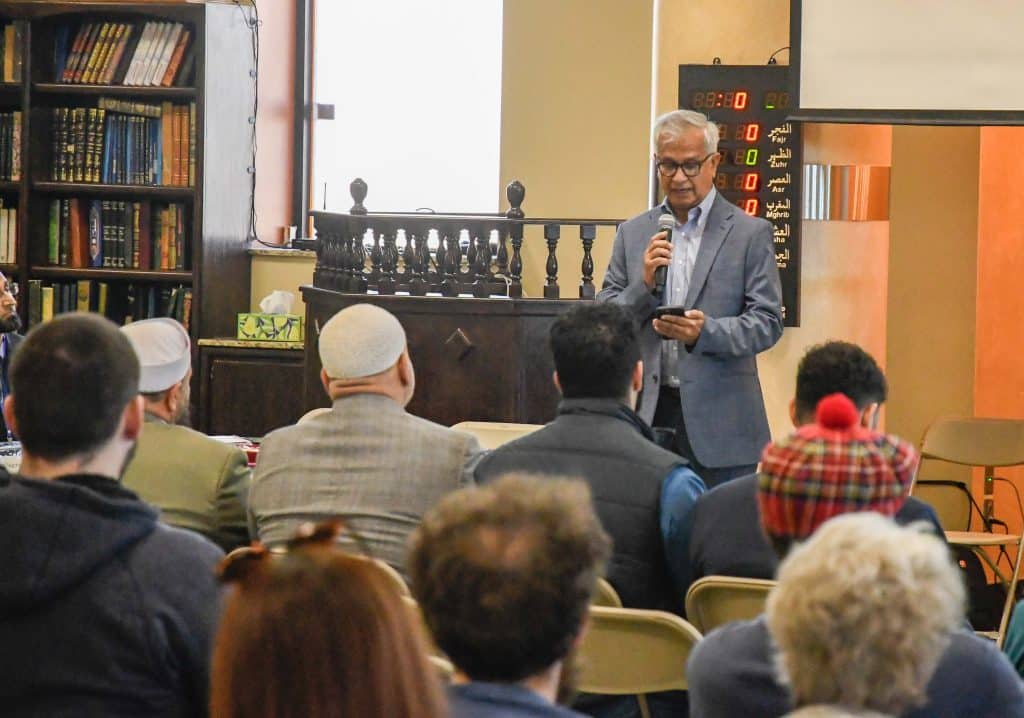
The IST’s new chairman, Sayed Newaz, told the audience Sunday that the Islamic Center stands as a spiritual and community institution.
“Here, we gather in prayer, support one another and reaffirm our responsibility to contribute positively to the city as well,” he said. “We all believe that understanding is built through engagement. When neighbors take the time to step inside, to ask questions and to meet one another directly, it strengthens the foundation of our community.”
Read our previous coverage of the mosque proposal in Broken Arrow here.
Newaz touched on the Broken Arrow mosque development, confirming the decision was indeed a tough one for members to process. “While that decision was disappointing for many in our community, moments like this remind us why engagement and understanding matter. They remind us that strong communities are built through a conversation, patience and mutual respect,” he said.
“Unity doesn’t require uniformity. It requires respect. It requires a willingness to listen, to learn and to stand together. Even when our perspectives differ, we share the same neighborhoods, same schools, and the same hopes for our family’s futures.”
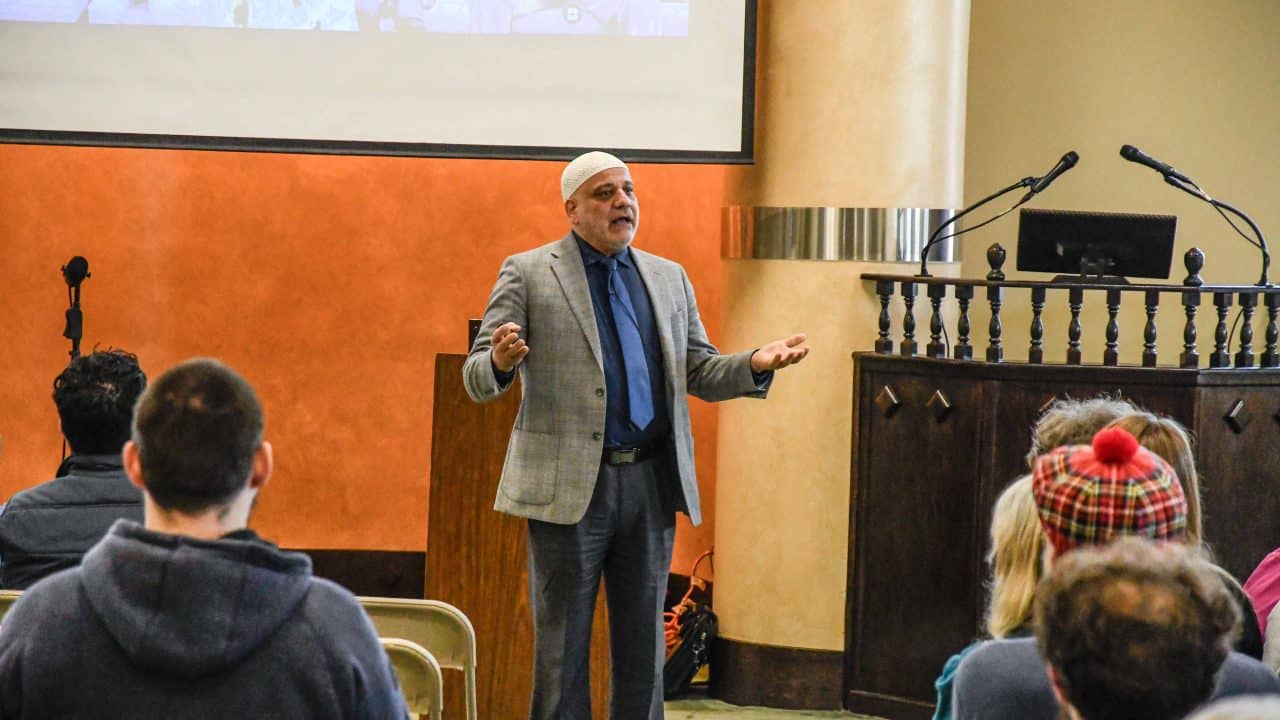
Imad Enchassi, senior imam of the Islamic Society of Greater Oklahoma City and chair of the Islamic Studies Department at Oklahoma City University, delivered an overview of the Islamic faith and addressed some of the popular misconceptions about the religion.
Enchassi, born in Lebanon, put a picture of his family on the screen in front of the audience and sought to dispel stereotypes about Muslim culture. His mother is Syrian, his father Palestinian and grandfather Egyptian, and his wife is Native American and Hispanic.
“Even as a family, we have theological disagreements about many things. But at the end of the day, we pray and we sit down on the same table because everybody has a seat at the table,” Enchassi said.
The religion of Islam, he said, centers around surrendering to the will of God, and a Muslim is somebody who submit their will to God and, by doing so, obtains absolute peace, tranquility and security, and attains salvation toward the end of time.
Jihad’s Real Meaning
He also took time to address the word jihad, which he believes, “is the most beautiful word in the Arabic language,” but has become associated with violence.
“The word jihad means to struggle, to strive to exert oneself to be in good at standing with God. This word has been taken out of context and brutally misinterpreted in many different ways,” Enchassi noted.
“I have my students at Oklahoma City University go deeper into that in the roots of the word, because you would see verses in the Quran that God almighty said do jihad, right? That means to preach the Quran, do jihad with morals. It means to be morally upright.
“Do we have fringe elements and extremist groups? We do. Do we have monopoly on that? We don’t.”
Enchassi said the best place to learn about different religions is to attend their services and ask questions, whether it’s about Islam, Judaism or Anglican faiths.
He also touched on the term “islamophobia” adopted by Muslims communities to describe fear, hatred or prejudice directed toward Islam and Muslims that manifests as discrimination, bigotry and violence.
Enchassi mostly blamed this on hysteria caused by the “three P’s” — pundits, politicians and pulpits, he said. About 1% of the U.S. population is Muslim but there is a misconception about Muslims attempting to take over the country, he added.
The percentage of Muslims living in Oklahoma is about the same as national averages, Enchassi said, which was boosted several years ago when about 1,500 Afghan refugees were welcomed to the state due to its interfaith relationships.
Schools of Thought
During a 20-minute question-and-answer session, Enchassi was asked if there are many different “denominations” in Islam as there are found in Christianity, where there are similar beliefs but different practices.
Muslims tend to use phrase “school of thought” rather than denomination, 90% of Muslims identify as Sunni Muslims and about 10% are Shia. In North America, “the distinction is not there,” he said, and there are Sunni and Shias in the Tulsa mosque worshipping together.
A woman from Broken Arrow who is Christian asked what can be done to promote more understanding between those of her faith and Muslims in the community. Enchassi said “being an advocate” is best by sharing knowledge accumulated through having better understanding of Islam.
“Each one of us has a privilege that we could use. I travel to many places where Christianity is not the majority religion. And since I know the facts about Christianity, I stand up and say, ‘This is not correct. This is not factual, this is not what Christianity teaches,” Enchassi said.
“So each one of us have a privilege that we could use to lessen the impact of Islamophobia. And we honor and thank anybody that stands with us.”
“We are proud to be part of this community, proud to raise our families here, proud to contribute to its continued growth,” said Newaz.


Leave a Reply