By John Dobberstein, Editor
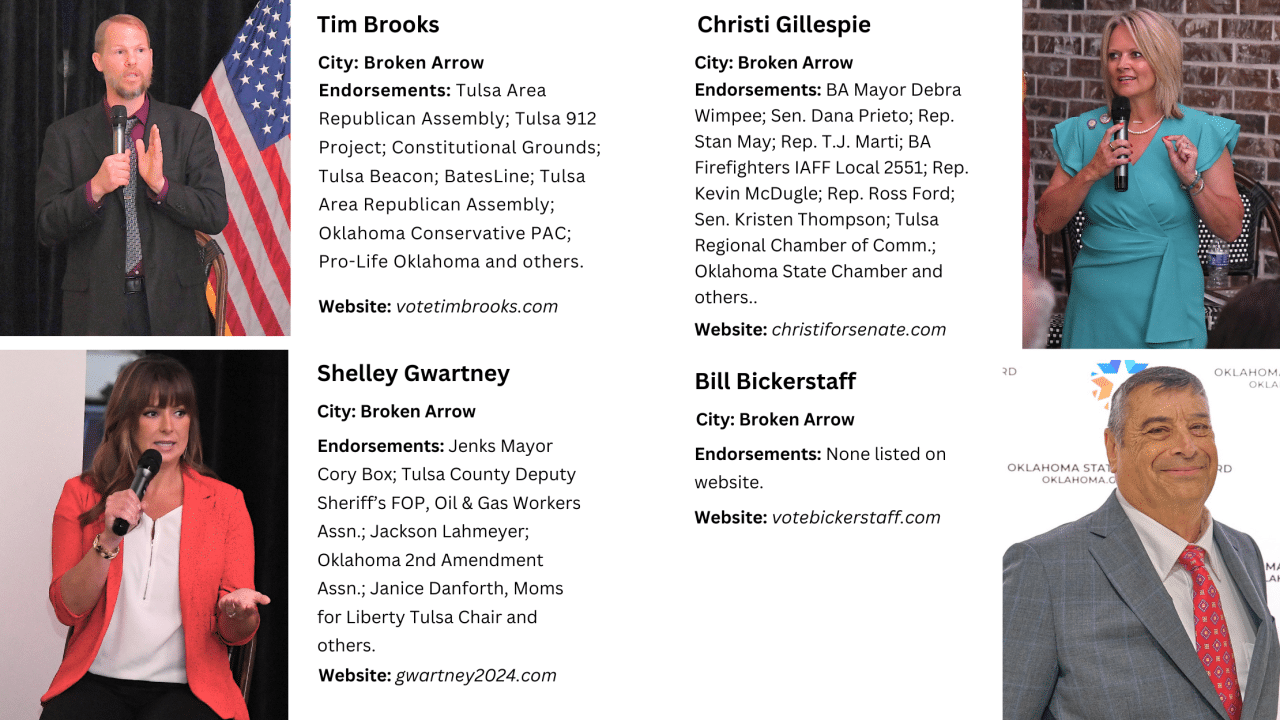
This is the second of a three-part series that will examine the positions of four Republican Senate 33 candidates on crucial issues facing voters. Their answers were pulled from a comprehensive candidate forum recently held in Broken Arrow hosted by Citizens for Liberty.
The four official candidates are Bill Bickerstaff, Tim Brooks, Christi Gillespie and Shelley Gwartney. Much of District 33 lies within the city of Broken Arrow corporate limits. Bickerstaff was unable to attend the candidate forum and did not furnish answers to questions by deadline. But more can be found about his campaign here.
If one of the candidates reaches above 50% of the vote on June 18, they will face Democrat Bob Willis in the Nov. 5 general election. If no candidates reach that threshold, a runoff election between the top two vote-getters will be held Aug. 27.
The first article discussed legislative priorities of the candidates and tax policy. Our second article explores the candidates’ stances on abortion and Oklahoma’s educational system.
Q: Right now in Oklahoma, a woman can only have an abortion to save her life in a medical emergency. Is Oklahoma’s current law on abortion too harsh, or too weak? Or are we fine with where we’re at?
GILLESPIE: I am absolutely pro-life. I believe our law is right where it needs to be. And this is just one more reason why we have got to get these liberal judges out of the system. It is ludicrous to me that our legislature can pass laws and the Supreme Court turns around acts like it doesn’t matter. Our lawmakers are elected by the people of this state who are passing laws and they’re being overturned. I believe that life begins at conception and I cannot imagine my life without my daughter and my grandsons. And I know people make choices, but not in the state of Oklahoma.
BROOKS: I’m absolutely against any form of abortion. I think there’s more that we as a society can do to help people when they find themselves in a crisis that they don’t have to turn to desperation. There are things that we can do. Is that a state responsibility? Is that a government’s responsibility? No, it is the church’s responsibility and that’s what we should be focusing on.
GWARTNEY: I also agree life begins at conception. I saw a really cool video of it recently of under a microscope. They’re watching the second that the sperm and egg meet and there is an actual spark of light. And you can see on the video, it is beautiful. It’s amazing. How do you deny that something didn’t happen in that moment when you see that? I’m very glad that we have that on our state law.
Q: The state’s current position from the governor and the attorney general is that we do not punish women who seek out abortions, but we go after those who perform the act — such as the doctor or someone assisting in the performing of the abortion. Should some of the responsibility for an abortion be on the woman seeking or having one?
BROOKS: Categorically no. We do not demonize women. If they find themselves in a situation, whether it’s their own choice or whether it is thrust upon them, we do not demonize them or criminalize them. We can give them the help that they need. But those who are performing the abortions, absolutely we should go after them. And we should take their medical licenses away.
GILLESPIE: I’m not sure how you would arrest a woman for going to a doctor, because you have to have the proof of it. I’m not sure it would actually make a case in court. But you can make that case for a doctor who is deciding to take a life.
GWARTNEY: My brother is on the Tulsa police force and we’ve had this conversation about the abortion pill. He says, ‘I can’t go into somebody’s home, even if that’s what she’s doing in her bathroom. I can’t go into her home and stop her.’ How would you prove that? Thinking outside the box, what resources can we provide when we do know that she’s done that? Maybe some classes she can go through to help her not go through that same situation again. But I would agree that we revoke the licenses of any medical doctor that (performs an abortion).
Q: Oklahoma’s education rankings, when compared to other states, have been some of the worst in the nation. What should be done to improve our standing in the very near future?
GWARTNEY: We need to get back to basics to see any change in our test scores. Teachers don’t have time to teach math and science when they are forced to spend 20 minutes asking each kid, ‘How do you feel today?’ when they have to do social emotional learning (SEL) based on what their school administrator says. They can’t get through the lessons. We must support the (Oklahoma) State Department of Education in making those hard choices and bringing uncomfortable change that may hurt for a while. And holding our administrations accountable to their test scores that are reflective of their district, and doing the things needed to move school board elections.
GILLESPIE: We need to get back to basics — reading, writing, literature, history, science — real science. We don’t have to teach kids what their gender identity is in third grade. It is not a teacher’s job to teach sex education other than the science of how it works. In elementary school, our teachers should be allowed to enforce some sort of discipline. And what happens when you call a parent and tell them, ‘Hey, Johnny’s got to go home because he’s in trouble.’ Guess what happens? The parent takes care of Johnny to make sure that he doesn’t do that again. If you wait until they’re 15 and send them home, a lot of parents don’t care because Johnny can take care of themselves. But they have to leave work. If we can handle those disciplinary issues at the elementary school level it would make a huge difference.
BROOKS: Over 85% of the rules in a classroom come from the federal government. What we get for that is 13% to 14% of our education budget. That is a disparity, right? What we need to do in Oklahoma is to divorce ourselves from the federal government that worries us so much in terms of time, where we’re not trying mindlessly test. And we need to cut some of the dead weight in schools. There is a school I’ve talked about before that decided to hire an assistant principal which was shared between four elementary schools. Now, each one of those schools this year has an assistant principal. Why do we need three more positions to be filled? We’re not putting money into education. We’re putting money into salaries, and we need to make some of those hard choices.
Q: How much of a school’s performance and direction should come from the state — state lawmakers and the State Department of Education — versus it being in the hands of the local school board and district administration, commonly referred to as local control?
BROOKS: I believe in local control, but what happens sometimes is the local control gets out of control. Our entire education system needs to be revamped. I’m a firm believer in local control, but we have to give those above that opportunity to come in and, unfortunately, micromanage when people we’ve elected are just trying to funnel money into their spouse’s bank accounts. You must have the ability to make those changes.
GILLESPIE: I believe in local control, and I also am a supporter of Ryan Walters. I’ve heard a lot of people complaining about Walters because some people don’t like the way he talks. And what I said to them is, just because someone says something in a different way than you would say, it doesn’t mean it doesn’t need to be said. When I go to the doors, guess what? I’m not hearing anything about Ryan Walters. It’s so interesting to me because he’s got results. As a result of that, people are happy and they still want accountability. I think that accountability that comes from the State Board of Education is great. But we do need to leave local control to school boards. There are some amazing school districts in our state, and unfortunately the bad school districts are making the great ones look bad.
GWARTNEY: Local control is the best way to have accountability. The people who are electing their school board members know their school board members. They’re talking to their constituents. That’s not something we’ve seen. It’s not something we’ve seen at Union Public Schools at all. The best system is that the people who are sending their kids to that school would know that people making decisions on curriculum, on budget, on hiring personnel, on classroom management. And as long as those are going well, you’ll see the results district from district. Our job is to protect your rights.
Q: Do you believe our current options for school choice when it comes to tax credit vouchers are good enough? And would you have voted for the system put in place last year?
GILLESPIE: I always want to give power to the parents. Parents are the only ones that have control over their children. When we talk school choice, that is what we’re talking about: parents are getting to choose where they want to send their kids. And we shouldn’t always be teaching to the test everywhere, because all we’re doing is making testing companies richer. I do believe that vouchers are working. At Broken Arrow Public Schools we haven’t really seen a decrease in the number of kids because we have a great school system here. We have our issues just like other places, but then it is the school districts that have issues that will see a decline, but they’re the ones that should see a decline. If parents make that choice to move their child, whether doing a private school or home school, that is their choice.
GWARTNEY: I’m glad vouchers didn’t pass the first year it was introduced. Anything that looks and smells like socialism should be looked at closely. When it’s somebody else’s money, I don’t want to get involved. When they changed it to a tax credit that was something people could get on board with. Our family is one of the families that was a recipient of that. I’ve seen many families helped by this, and we know that competition spurs greatness, right? It creates change. And so having the option will make it uncomfortable for some school districts, which will then put pressure on the administration to make decisions that they haven’t had to make. This is moving forward as long as we’re making sure that we’re not spending other people’s money doing so.
BROOKS: I also would have said yes and voted for the bill. Is this bill good enough? No. The Oklahoma Tax Commission is arbitrarily changing the definitions of the meaning so that some people, instead of getting the full benefit, only receive half the benefits after they’ve already enrolled and they’re already gone through almost the entire school year. Suddenly now they’re not getting the full $7,500. This is incremental change, but I don’t think that the public school systems are feeling the pinch. We need to increase that incentive to make the public schools feel the pinch to make those school administrators make those changes, and to really press on that side of the issue to improve our public education.




Leave a Reply