By John Dobberstein, Editor
COWETA — As Coweta city planners prepare for a public hearing Monday about the proposed 400-megawatt data center, more information has surfaced about how the developer’s planned financial contributions to the community and how the facility will be operated.
Much of the information about Project Atlas coming to light recently was provided after lengthy lists of questions sent by residents and a member of the Coweta Planning Commission, which will hold a hearing on the data center rezoning request at 6 p.m. Monday at the Indian Capital Technology Center (ICTC).
Opposition to the data center has been significant due to concerns over noise, potential effects on water and electrical demand, environmental impact, property values, reduction in green space and animal habitat, among other reasons.
When asked about this by a Planning Commission member, Beale said it wants Coweta to feel connected to the project and be part of a “long-term partnership,” and that company representatives have spent time in Coweta meeting with community stakeholders and residents.
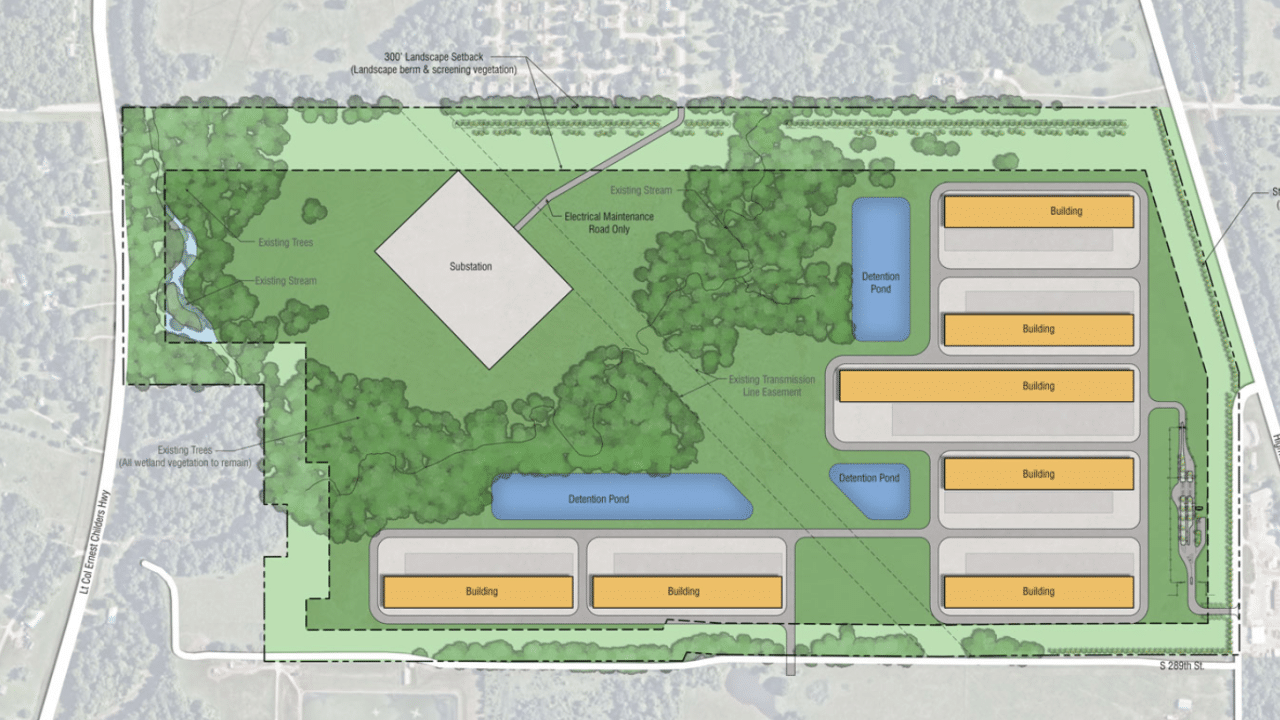
Beale said that after the open house last year, feedback provided by the community was incorporated into the site design, including increased vegetation screening and berms around the property edges, “to limit visual and audio disturbances,” as well as lowered building heights.”
Despite the opposition, Beale said there is “broad support” from trade workers and women due to opportunities the project can provide, and Project Atlas will create “high-wage job opportunities across a variety of sectors, including construction, local contractors and suppliers, plus full-time on-site jobs available for a diverse set of skills and educational backgrounds.
“These benefits of digital infrastructure projects to the American worker are not ‘temporary’ and we are proud to partner with local education and training programs to support the expansion of workforce development programs that will ensure we can prioritize local hiring.”
What Coweta gets
As of Sunday, the final version of the legally binding agreement between the developer, Beale Infrastructure, and the city hasn’t been released. Beale said its initial proposal to the city was countered and negotiations are continuing.
Up to this point, Beale says that based on power consumption the city will be paid a franchise fee of $2 million to $5 million per year. The developer has offered to pay $500,000 for water master plan study to map the City’s water infrastructure.
Beale would also contribute $3 million for Coweta City identified water projects and another $3 million for improvements to Roland Park. Beale has also offered, “local job fair and placements including our general contractor and sub-contractors.” There are continued discussions around potential financial investments in athletics.
The final tax incentive package Beale would receive also hasn’t been revealed, although Beale is expected to contribute payments in lieu of paying property taxes. At full buildout, Beale says it is contractually bound to pay, over the next 25 years, $117 million to the Coweta Public Schools, $50 million to the city of Coweta, and Wagoner County $22 million.
Even without paying property taxes, the company said, Project Atlas would be the largest taxpayer in the city on a per-square-foot basis, and the largest overall when the project is fully built out.
Beale promised it would partner with local schools and training programs to provide added benefit to the Coweta area, “to make sure residents … have opportunities for higher wages and access to the jobs created by this project.”
Beale said it’s having conversations with the ICTC and has reached out to Coweta Public Schools about improving existing educational programs. In other markets the company said, it has worked with high schools and community colleges to build trades and IT-focused programming.
“We prioritize local hiring, and creating pathways to employment through partnerships with local schools and training programs is critical to our project,” Beale said. “We will look to establish a variety of programs including STEM, trades, and other technical programs, as well as sponsor unique opportunities like robotics clubs, for example.”
Demand on water, power
Beale maintains the existing electrical grid can accommodate the project’s load and that was confirmed by PSO studies.
Beale repeated that it’s paying for all infrastructure upgrades, per a contract it signed with PSO, “which enhances grid reliability for the surrounding area and allows for future utility expansion.”
Beale says PSO’s recent rate increase was approved, “before our project became a reality” and the utility has publicly stated the project won’t raise residential and small business rates.
Data center cooling
The data center is expected to use a closed-loop air-cooled system to cool the data center that doesn’t continuously consume water
The only water needed for the cooling system, Beale said, is the amount to fill the closed loop initially, and it is then continuously recirculated. The facility is estimated to use 15,000 to 20,000 gallons per day. “Other cooling options were explored during the design phase,” Beale said, “but ultimately the air-cooled system was selected to minimize our water footprint in the community.”
Although final details aren’t decided yet, the cooling loops may be filled with propylene glycol, a biocide to prevent biological growth and/or a corrosion inhibitor, as well as water.
Beale said the additives are intended to be contained and not released into the environment or wastewater system, but in case of an accidental release substances used in current systems are designed to cause as little impact as possible.
“Soil contamination is not a concern for this project, no more than it would be for any standard office or warehouse development,” the company said.
How loud will it be?
Beale has said the project is designed to operate at 55 decibels, with a maximum 65 decibel limit at the property line, only reaching max level during emergencies. “Data centers lack the heavy machinery, production noise and truck traffic associated with manufacturing or other industrial facilities,” the company said. “This facility is designed and will be built with the surrounding uses in mind.
“For comparison, normal conversation ranges from 60 to 65 decibels, residential areas range from 50 to 55 decibels, while a traditional manufacturing facility ranges from 80 to 90 decibels.”
Beale said it will be complying with all noise and emissions requirements and adhere to federal, state and local mandated requirements regarding testing from backup generators. Further, Beale will adhere to the requirements to pull an air permit from ODEQ and the air quality division, which verifies emissions and operational data.
Impact to environment
Beale said the proposed site plan has detention ponds that are designed to be dry when not in use after a storm event.
The company completed preliminary “internal” wildlife assessments during the acquisition phase of the project to, “inform initial site design and ensure we avoid sensitive resources from project initiation.”
Using the surveys, Beale said it has established permanent natural buffer areas to ensure preservation.
Once the design is finalized Beale said it will conduct “comprehensive studies” and follow applicable state and federal protocols and any formal reports and subsequent mitigation plans for specific permits will be reviewed by state agencies and the public would be able to comment.
“Though our assessments did not identify any federally designated critical habitats in the project area, the project will observe mitigation measures to further reduce any impact to species that may have the potential to occur in the geographical region, such as the tricolor bat, monarch butterfly and migratory birds,” Beale said.
“We will observe tree-clearing windows and refresh all biological field surveys to date before any tree disturbance and will maintain over 600 feet of setback from any identified bald eagle nests, while seeking consultation from a qualified biologist.”
The company also plans post-construction revegetation as needed to further enhance the monarch butterfly habitat in the area.


Leave a Reply