By John Dobberstein, Editor
As the gubernatorial campaign in Oklahoma gets into full swing, the current frontrunner — longtime state lawmaker and Speaker of the House Charles McCall — made a stop recently in Broken Arrow and sat down with the Sentinel to talk about some of the biggest challenges facing the state and what he planned to do to solve them.
While Oklahoma’s economy is generally growing and doing well, the state house has also received negative attention due to misspent federal funds, political gamesmanship among educational leadership, acrimonious battles with tribal nations, controversial state questions and skyrocketing homeowner insurance rates.
A survey by Stratus Intelligence in September taken by more than 800 likely Republican primary voters found Attorney General Gentner Drummond with 35% support and McCall at 33%. A three-way ballot test including former state official Chip Keating, Drummond polled at 32%, McCall at 31%, and Keating at 6%.
But another poll taken by Stratus Intelligence in October of a similar number of likely Republicans showed McCall leading Drummond by 8 points in a head-to-head matchup (45% to 37%), and in a projected runoff McCall extends his lead to 13 points (49% to 36%).
Much of the shift, according to the campaign, is driven by McCall’s growing support among conservatives. The survey says 75% of GOP voters now rate McCall as conservative, a 13-point increase since September, while Drummond has dropped 15 points, with only 38% now viewing him as conservative.
Q: Why would you be more effective as a governor than anyone else in the race?
McCall: “Quite honestly, I’ve served in multiple levels of government. I was a councilman for a year. I was a mayor for 7 years. I was elected to go to the State House of Representatives, where I served for 12 years — 8 of those as Speaker of the House. I got to see the worst of times economically in this state. When I became the speaker, we were in a 4-year revenue contraction cycle and no reserves, and we got the economy turned around and went from the worst to best with $5 billion in reserves when I left last year.
“If people are doing well, and business is doing well, the state’s going to do well and that’s what we experienced. Once we got the economy turned around, economy has doubled its output. The first year I was a speaker, the annual appropriated budget was roughly, $6 billion. When I left it was $13.2 billion. It’s not that we grew government, we actually cut taxes. We had a great economy.
Q: Although you have considered yourself the most conservative candidate in the Republican primary, Gentner Drummond (a fellow candidate) recently described you as an Obama Democrat and launched a website around those claims. What is your response?
McCall: “I’ve always been a conservative and like President Trump, Reagan, and a big chunk of today’s MAGA movement, I too was once a registered Democrat. As the Tea Party movement swept aside the GOP establishment, I proudly switched my registration to Republican 15 years ago, along with most of my neighbors in southeast Oklahoma. I became the first elected Republican in District 22, and I have a 12-year, conservative voting record and tenure as Speaker of the Oklahoma House to back up my core conservative beliefs.
“That includes passing the toughest immigration laws in the nation, cracking down on foreign land ownership across our state, passing the largest tax cut in Oklahoma’s history, and banning mutilating gender reassignment surgeries on minors. Oklahoma voters should be concerned about our Attorney General (Drummond) recently donating to extreme liberals like the leader of the Oklahoma Democratic Party, Joe Biden when he ran against Donald Trump, and his family heavily supporting the anti-Trump Lincoln Project. I am the only viable candidate in this race that can say they supported President Trump all three times.”
Q: We have 39 federally recognized Native American tribes in the state of Oklahoma. There’s always going to be challenges and tough negotiations to overcome. But there could also be opportunities. What would be your approach to working with the tribes?
McCall: “My approach would be to have a weekly conversation and be available whenever tribal leaders want to reach out for a conversation. I will have a state tribal nation task force or cabinet on tribal relations and try to have a good working relationship. It all starts with just good communication.
“Those who elect the tribal leaders and those who elect our state leaders won’t agree to certain things. But the leaders must have a good working relationship. Don’t let the things that can’t get done keep you from making positive progress.
“No matter how tough the issue is, if you just have a good working relationship and keep things functional, the stars will align. This is their home. The tribes aren’t going to any other state. And we’re all Oklahomans. Compacts are important between the state and the tribal nations. But within those compacts, the agreements need to be a good for all Oklahomans. If they’re not, then you must keep working on them.”
Q: You said you wanted to fix our state’s broken educational system. How would you go about doing that?
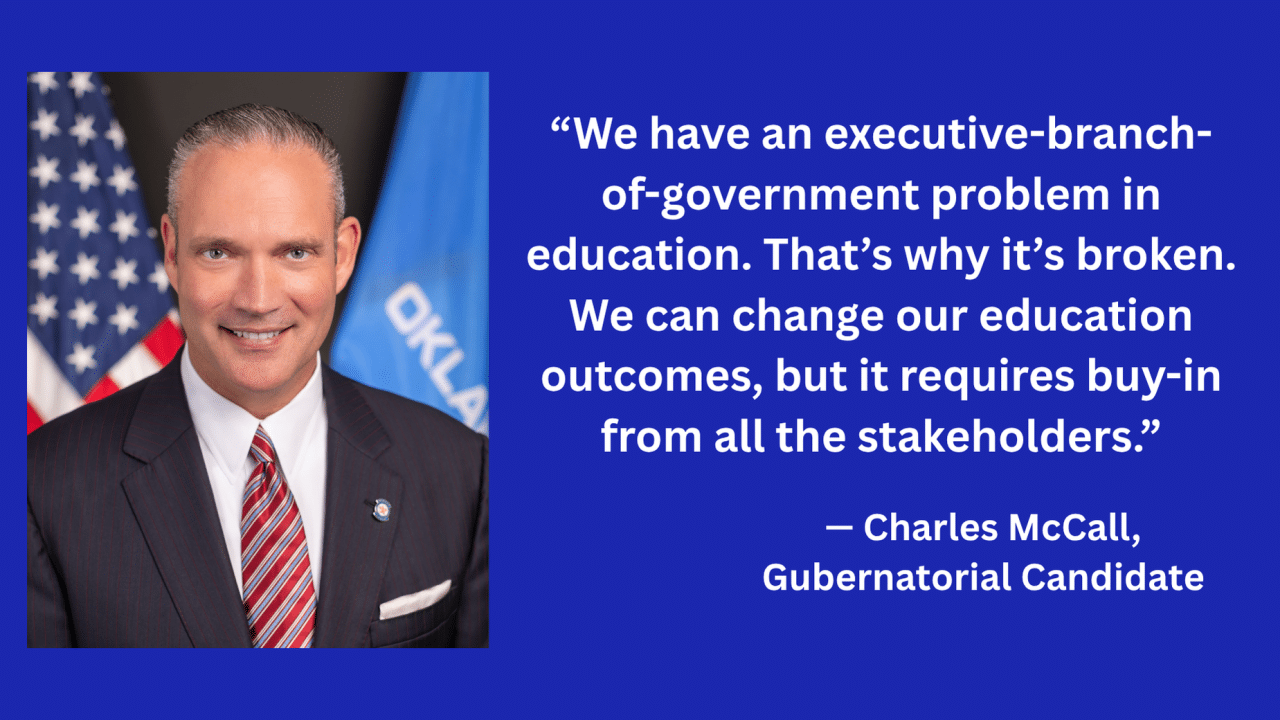
McCall: “We have an executive-branch-of-government problem in education. That’s why it’s broken. The legislature did some amazing work over the last 6 or 7 years getting caught up on the funding, with $1.5 billion new recurring dollars every year and 3 teacher pay raises. We have universal school freedom here, which means every parent, regardless of where they live, can find the best school for their child. But the executive branch needs to pull it together.
“We can change our education outcomes, but it requires buy-in from the people of the state and all the stakeholders. Mississippi used to be behind us, and now they’re the 15th best in the country. And the way they went from 49th to 15th was they focused on the areas that they were deficient — reading, math and science. And they focused resources on tutoring and reading coaches for the poor-performing schools. They didn’t let kids promote beyond third grade that weren’t reading on level. The state of Oklahoma had deviated from that for a while.
“We could talk about supporting our teachers in the classroom more on behavioral issues, and the administrations need to focus on doing that. I feel like we need to get the political activism out of our schools and focus on teaching, reading, writing, math, science and critical thinking.
“Every kid takes the ACT, but not every kid is going to college. They shouldn’t take the ACT. The other states don’t make all kids take it. What does that do to our ranking? It shows us that we have a weaker ACT score than the other states. There’s some simple things we can do. But we certainly have deficiencies and will have to focus resources on bringing up reading, math and science.
Q: The governor asked state lawmakers to have the superintendent of public instruction be appointed rather than having it be an elected position. Do you support that?
McCall: “That’s the purview of the people of the state. Whatever they do, whatever they say is what we’ll do. At the end of the day, people need to understand elections have consequences. If it were an appointed position, then truly the accountability would reside with the governor. If they do a poor job, the governor can make a change. I see some merit in that. Four years can be a long time if somebody’s not delivering outcomes.”
Q: People in the state are very concerned about homeowner insurance premiums. What would you do about it?
McCall: “I think the state must demand some certain minimums in the business realm. There needs to be more competition. We have a trend in the U.S. where the big (providers) are getting bigger, and the smaller firms are getting pushed out. We must stop that. You can’t have monopolies or oligopolies. That leads to antitrust situations. We’ve got to find a way, even if we have to have regulatory boundaries.
“We also we need to work with the federal delegation because some of this involves interstate commerce issues. Some of these companies do business in every state. Yes, we have some tornadoes in this state, but when there’s wildfires in California or a hurricane in Hawaii, that should not be an excuse for rate payers in Oklahoma to have to pay more.
“I’m very concerned about the escalation of costs. I see it in my business and in my own insurance on my home. And I’ve noticed the companies continue to make profits every year, but everybody else is not even seeing flat rates. We’re seeing rate escalation year after year.
Q: There has been plenty of news of late about corruption and fiscal mismanagement in state government, such as with the Department of Health and Human Services, investigations of the former public schools superintendent, financial problems with the Department of Mental Health, a $3 billion overrun with Access Oklahoma and pandemic money allegedly not being spent properly. Is there anything we can do to tighten up the financial controls and protect taxpayers?
McCall: “The governor needs to be a strong administrator. I’ve worked through every department of our family’s company. I’ve had that experience in the private sector and the public sector through public service. With Mental health we’ve seen problems there with the last two governors. There was a crisis with Gov. Fallon. They showed up in my office on a Monday and said we need $30 million by Friday or we’re shutting down every county health department in the state.
“I said, ‘Why are we just now finding out about this? At all our hearings the agency said it was just fine.’ We provided the $30 million and then did a deep dive audit. They had the $30 million, they just didn’t know where it was. For the first time since I think the 1930s, the legislature exercised their statutory authority to fire an agency head. The problem is the director was an excellent clinician who knew mental health but had no administrative skillset with money.
“DHS is the agency I got the most complaints on when I was in the legislature. They’re too big and they’ve been fragmented. Previous governors have shut down other agencies and piled their missions on DHS, so it looks like government is smaller. And it didn’t really build out a functional structure to deliver the mission.
“DHS will have to be overhauled. It shows multiple signs of taking unilateral action that violates people’s civil rights, and that’s going to stop. There will be no excuse for it. I will ask the legislature to grant me more authority over the agencies.
“The truth is we have a weak form of governor in the state of Oklahoma under our Constitution. I’m going to ask they can grant the governor more authority to reform those agencies. If they don’t like what I do, they can strip me of the power. But I’m going to get it cleaned up. I’ve done it in the House of Representatives. I’ll do it in executive branch as well.
Q: There has also been a lot of concern about state questions causing disruption in Oklahoma. What’s your view on what should be done?
McCall: “We have out-of-state groups exploiting a mechanism in our state’s constitution coming in and finding a few people in Oklahoma to push very progressive extreme concepts and ideas. We have marijuana and it’s now full-on recreational. We’ve got Medicaid expansion in our state’s constitution through that. Now we’ve got one coming to change our election process to open primaries, which will completely flip upside down our election outcomes.
“I’m completely opposed to all the state questions that are coming. We don’t need a bigger front door. We don’t need to be making decisions that create more problems for ourselves. These state questions are bringing processes to the state and legalizing things that other states have done before us who have had terrible outcomes.




Patrick Hoey says
I would like to see a similar Q & A with Getner Drummond. The questions are relevent and express concerns of most, if not all, of northeast Oklahomans. However, without AG Drummonds point of view on these issues we’re hearing only one side of the possible solutions to our challenges.