By John Dobberstein, Editor
Wagoner County voters face some major decisions Tuesday when they decide on eight tax propositions on the ballot, with some making sales tax levies permanent and others raising additional funding for projects through new sales taxes.
Counties were given the power to levy sales taxes in 1984 to bolster sagging revenue streams, but they are capped at 2%. The current Wagoner County rate is 1.3% and if all of the proposed questions pass, the new sales tax rate would be 1.8%. That would translate, for example, another .50 cents for every $100 spent.
The propositions would not increase property taxes, utility bills or increase the county’s debt.
Proposition 1: This makes the existing 0.80% sales tax for county roads and bridges permanent. The purpose is to secure infrastructure funding.
Wagoner County Engineer Rachel Cooper has said $2.3 million goes to each maintenance district out of the sales tax fund each year, which is 68% of total the county can use for roads and bridges.
With the county having 864 miles of certified roads it comes out to about $11,500 per mile. If the sales tax was lost — since it isn’t permanent — it would reduce per-mile funding to $7,848 per mile. It would also eliminate county engineering, county economic development and emergency management, Cooper said.
“They are all funded through the use tax, which is tied to this,” she said. “If this is not permanent, the potential to bond off of additional use tax is eliminated. The bond would only be possible for 10 years and so that eliminates some potential of funding projects with our current tax base rather than going out for a vote for additional taxes.”
Proposition 2: The Wagoner County Sheriff’s office currently receives 0.10% of the sales tax for operations. This proposition will make that percentage permanent.
Proposition 3: This would make permanent the 0.10% sales tax for countywide services, such as insurance costs, workers compensation and other general liability policies.
Proposition 4: This proposition (question no. 4) will create a new county-wide ambulance authority by using 0.15% of the sales tax. It also leaves 0.15% of the sales tax going to the fire departments.
Wagoner County relies on neighboring counties and other municipalities to provide ambulance services but county leaders want changes.
“Ambulance service response times are abysmal. You have in some instances wait times of over an hour, even in city limits,” Cooper said.
“A responding agency may respond to an unincorporated area and then a need would take place within that responding agency’s jurisdiction to which case the wait would begin.
“This effort would be to reduce the wait times and provide a needed public service to unincorporated areas, but also provide ambulance services that would have interlocal agreements with all of our other agencies. So the goal would not be to reduce any ambulances, but to just enhance our response times and provide higher level of safety for our citizens.”
This proposition has seemingly attracted the most opposition, as members of rural fire departments have complained the measure would take money away from them.
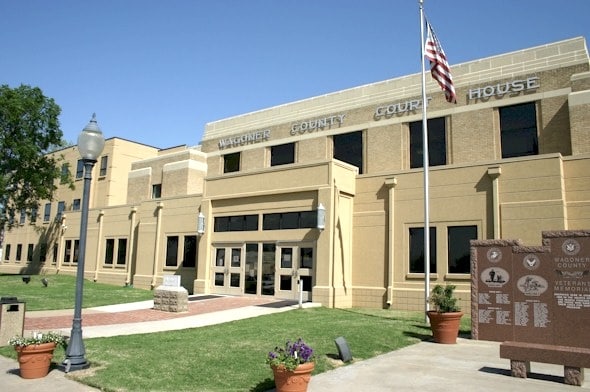
Proposition 5: This new temporary sales tax would be used for rehabilitating the Wagoner County courthouse, as well as improving access to pedestrian parking. The goal would be a $10 million fund and the tax would be for 30 years at 0.125.
Proposition 6: The proposition would establish a county trust to help with jail functions and enhance stakeholder engagement, as well as repair or rehabilitate the structures of the jail for security of personnel.
Voters will also be asked to approve a new 0.25 sales tax levy to fund a county jail trust.
Cooper said a properly trained, equipped and professional staff that is held accountable by leadership that takes a more proactive approach, is the first and best line of defense from excessive judgments.
Cooper said the use of county general fund as a primary or secondary source of funding may blur the lines of legal separation. So the goal is to provide some level of separation between the jail and county government.
“There are several jail trusts in the state. No jail trusts have received a judgment against them. They’ve settled a few cases in the past, but they’ve not received any judgments,” Cooper said.
“There are several cases in the state where judgments have been rendered well over $30 million. A jail trust would create some separation and provide a professional staff that can be paid in excess of what our current staff can be paid in hopes that that professionalism and that separation would protect us and provide some liability.”
Proposition 7: This measure would create a new funding mechanism to improve facilities at the Wagoner County Fairgrounds to house the Oklahoma State University Extension office and add exhibit areas, stalls, an arena and conference rooms for a total of 75,000 square feet of improvements. A new fairground location in partnership with the city of Coweta would be located at State Highway 51 and the Muskogee Turnpike, which is centrally located in the county.
Proposition 8: This establishes a county lodging excise tax of 5%. The funds would be used by Wagoner County to bolster tourism and build and maintain public spaces and recreation. The tax would apply to furnished rooms and recreational vehicles parked in RV parks for no more than 30 days.
The cities of Broken Arrow and Wagoner have lodging taxes so it would only impact those staying in unincorporated areas. “We’re looking primarily at Airbnb- and BRBO-type rentals,” Cooper said. “We do have a hotel and a resort, several RV parks and a conference center in unincorporated Wagoner County that this would impact.”
The county’s principal tourism is the Jean Pierre Chouteau Trail, a 59-mile recreational trail established by the U.S. Army Corps of Engineers in the late 1970s.
“It is currently in disrepair and has not been maintained for a number of years, but it is the longest recreational trail in the state and it is a gem that the county is proud to have and would like to reestablish it,” Cooper said.
In an interview with media gathered at a recent protest of the propositions, tax consultant and CPA Brent Watson – who lives in Broken Arrow on the Wagoner County side – said the sales level if all the propositions pass will encourage Wagoner County residents who work in Tulsa to shop there instead of at home.
He told KRMG earlier this month the “regressive” nature of sales taxes put the burden on those who can least afford it, especially younger families with children.
If the propositions all pass, he says, Wagoner County’s sales tax will be higher than the state average and among the highest sales tax rates in the nation, with residents paying about 10 cents on the dollar. Wagoner and Coweta would have sales tax rates of 10.3% and Broken Arrow 9.8%.



Leave a Reply