By John Dobberstein, Editor
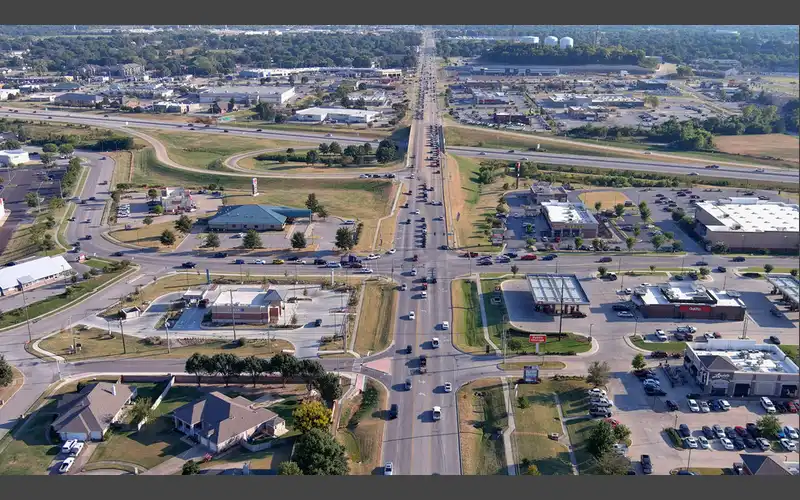
When Broken Arrow was founded and its population was much smaller, much of the traffic in town simply traveled north and south as retail and employment patterns dictated at the time.
That all changed when the Broken Arrow Expressway opened and fueled the city’s rapid growth, and as economic ties continued to develop between Broken Arrow and Tulsa, it brought renewed focus to how and where commuters travel today.
The infrastructure needs of Broken Arrow’s transportation system is the primary focus of Proposition 1 in the citywide April 7 General Obligation (GO) Bond election. The fate of some $205 million worth of road widening and intersection improvements, and other infrastructure projects, are going before voters. That amount represents more than half of the entire $415 million total being considered Tuesday.
The drainage and stormwater projects in Propositions 5 and 6 are intended to reduce flooding, improve drainage systems, and address stormwater runoff in key areas of the city. If these 3 propositions passed it would not increase property taxes.
More Lanes, Better Intersections
A large portion of the street projects are in south and east Broken Arrow, where platting for homes, businesses and retail developments has been rapid the last several years.
Olive Avenue and Elm Place both would be widened from New Orleans Street to Florence Road, and Olive from Washington Street to New Orleans would be designed for widening. Aspen Avenue would be widened from Dearborn to Omaha Street.

The east-west arterials of Tucson, New Orleans, Kenosha, Omaha, Houston, Florence, and County Line would also have stretches widened (see map). Intersection improvements would be targeted in much of the same general areas to help complete improvements to major corridors in the city.
Some $25 million would be budgeted for residential street rehabilitation, along with money targeted for 37th Street from Dearborn to Rockford, and Main Street from Urbana to Washington and Kenosha to Elgin.
Another $37 million is designated for improvements that are “second priority,” including traffic signalization, sidewalk and trail connectivity, downtown alleyways, Rose District repairs and restoring “Innovation Bridge” for the Arrow Forge Innovation District.
One question residents often ask is why the city doesn’t widen roads ahead of time to accommodate incoming development, rather than simply reacting. But City Manager Michael Spurgeon noted the city doesn’t always know when a given piece of property will be developed.
He used the example of County Line Road from E. 101st Street South to the Creek Turnpike, which was widened 20 years ago by Tulsa and Wagoner County — “and there probably hasn’t been but one or two new homes built on that road.
“When you have a limited amount of money, is it prudent to go out and spend money on speculation when we don’t know when the property is going to develop? Remember, people are concerned about the fact that the development is here now.”
If Proposition 1 doesn’t pass, some of the more urgent road projects could be set back several years in the planning process or never get done. “It’s not a threat. It’s reality,” he said. “There are a number of roads, mainly in this package, where the amount of traffic on them is near, or will soon be at capacity.”
There are a number of roads, mainly in this package, where the amount of traffic on them is near, or will soon be at capacity.
—Broken Arrow City Manager Michael Spurgeon
A 2024 survey by the city of 40 potential road projects for Broken Arrow indicated that for north-south arterials, County Line Road widening on certain stretches had major support, as well as adding a turn lane on Elm Place between New Orleans and Florence streets.
Through funding approved in the 2018 GO Bond election, construction is about to begin on widening County Line Road between Albany and Omaha streets to 5 lanes, with a new bridge structure on north end of County Line. The $9.1 million project will take more than a year to complete.
For east-west thoroughfares, widening Houston and Washington streets to 5 lanes from Aspen to Elm, as well as widening Kenosha Street to 5 lanes between Aspen and Rhema Bible Church rated highest in the survey.
Propositions 5 and 6 — Drainage and Stormwater
Water flow is seldom a hot topic with residents until something goes wrong and roadways and backyards are flooded. The city has 2 propositions totaling $11 million that would be targeted for stormwater and drainage improvements throughout the city.
Proposition 5 requests $6 million for stormwater projects in several spots in Broken Arrow, with the priority being drainage pond improvements for Madison and Birch Street ($1.5 million), $700,000 for drainage improvements in the Rose District, $1.5 million for improvements from Elgin to Inola Street and Date Avenue to Ash Avenue, and $500,000 for improvements in the Indian Springs area.
In Proposition 6, the city is requesting to borrow $6 million to improve drainage, with the priority on the Haikey Creek, Adams Creek, Broken Arrow Creek and Elm and Aspen Creek basins. There is another $1.5 million requested for “unnamed basin” that would be evaluated if the proposition passes.


Chuck McCall says
Does the City actually have a Storm Water Plan? I ask as a consequence of the on-going construction project at the West end of Miami Street has created issues for residents whose homes are adjacent to the construction as well as from the end of West Miami Street to past the intersection of W. Miami and Poplar Streets. The recent rains have left a considerable amount of residue on the street and some of that residue is from the cleaning out of ready mix truck chutes. The contractor has not done a very good job of maintaining the SWPP. Not sure if this is a failure of the contractor to comply of lack of enforcement by the city.