By John Dobberstein, Editor
It may sound odd, but to understand where the U.S. and Oklahoma economy is headed next year it’s best for business leaders and planners to know what you don’t know, says Russell Evans.
The interim dean and professor of economics at Oklahoma City University says reading the economic landscape right now requires a “reconciliation of those things we know with those we don’t.”
Evans believes current economic headlines – unemployment rates, job creation, sales tax collections – overstate the true health of the economy.
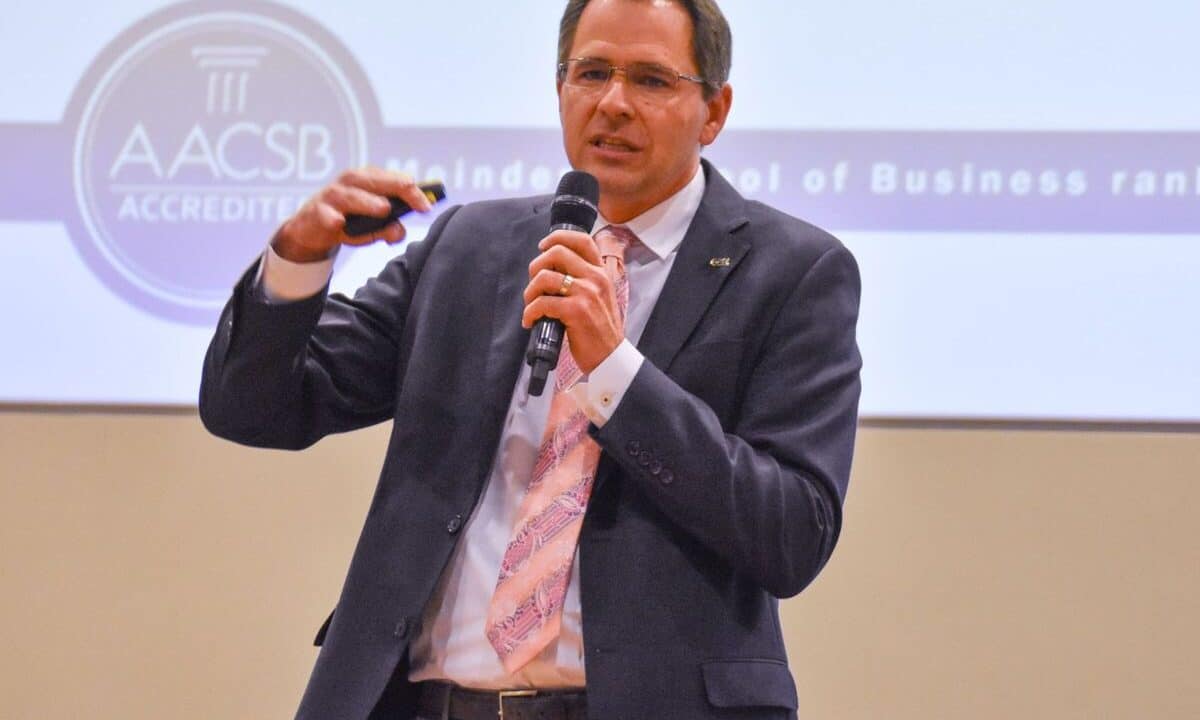
Here’s a summary of what Evans shared at the Broken Arrow Chamber’s Monthly Luncheon that featured the economic outlook for the U.S. and Oklahoma for 2022:
• Absent additional policy, support should ease through the middle of next year, bringing less headline-making economic activity.
• It’s not clear yet if Oklahoma is recovering from an oil bust or transitioning to a new paradigm with a fading identity as an energy state.
• It’s likely 2023 before pre-pandemic levels of economic activity across the board, with pre-pandemic levels of policy support, are seen.
• Evans says Oklahoma’s general revenue funds are not likely to pose a concern over the outlook, as strong energy prices and slowly increasing production will offset losses from policy withdrawal. And the state’s rainy-day funds are in a strong position.
• Single-family home construction and sales are expected to remain strong, as there is sufficient demand from household formation and in-migration to support home prices.
• Pandemic policy response, and the consensus that energy-supported economic activity is virtuous, might suggest a longer transition to peak oil and natural-gas demand.
• Goods sectors will be strong this year and over the 2022 outlook than previously thought.
One of the difficulties in forecasting economic conditions for the near future, he notes, is that historically stable trends and seasonal factors that are normally used to model cyclical behavior have been “blown up” by the recent policy responses of the federal government, such as direct payments made during the pandemic.
For updates, subscribe to our free newsletter!
“At the end of the pandemic response, what happens is production goes down. We’re producing far fewer goods and services in the state. Far fewer people are employed. We have far fewer wages and salaries being paid, and yet incomes are at an all-time high. It kind of just blows up these relationships,” he says.
Evans says the Delta variant of the coronavirus is expected to slow, rather than stall, economic recovery in the U.S., and positively, Gross Domestic Product has recovered to pre-pandemic levels a quarter earlier than expected. U.S. employment levels, however, may not recover to pre-pandemic levels until mid- to late 2022.
Inflation is “well outside out the policy target” but Evans says analysts are questioning if it’s temporary and transitionary as supply chain disruptions resolve, or if it’s consistent with the new policy guidance of inflation averaging.
“The true state of our economic health is still unknown,” Evans says, “but maybe the policy-fueled appearance of economic strength is our new true state.”
When the pandemic was waging war on the U.S., he says, “Nobody was at the factories. Nobody was building the intermediate goods and services in the supply chain that are necessary. And then 3, 4, 6 months later, we opened back up. We began to consume goods and services again. And now we’re at the end of the supply chain.
“We’re trying to buy goods and services, but everything intermediate has been shut down. And so, you can sort of imagine like a bottleneck on a highway off-ramp. Once you get that bottleneck, it takes time to unwind.”





Leave a Reply