
Source: Tulsa Airports Improvement Trust
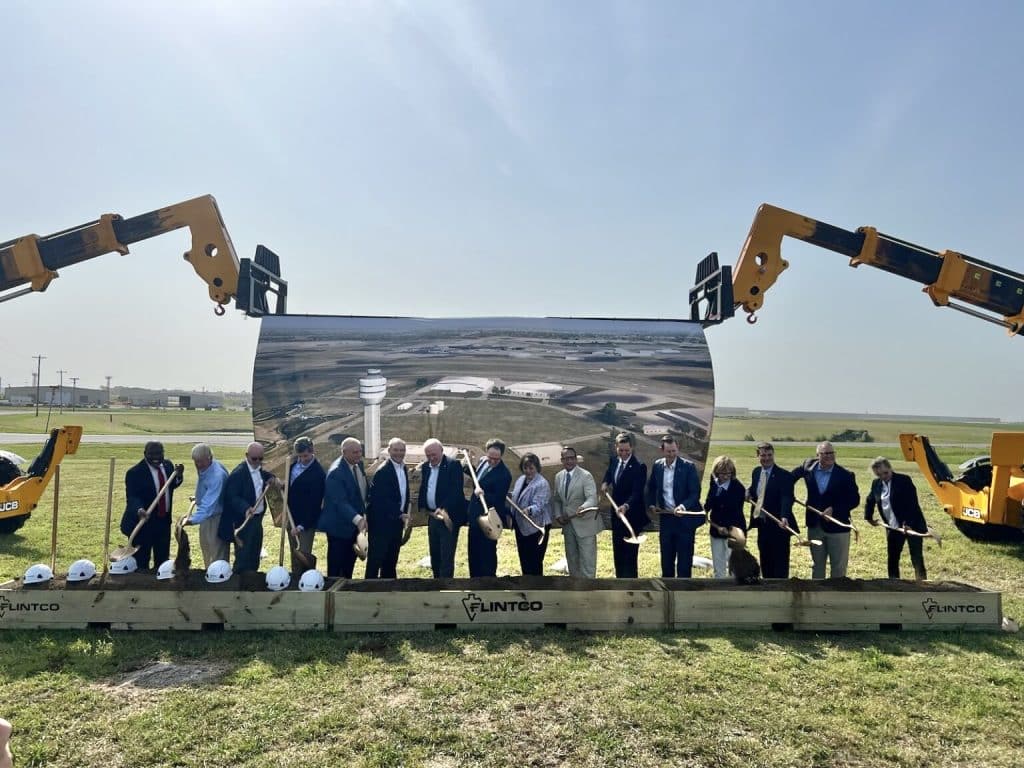
TULSA – Tulsa International Airport (TUL) celebrated a significant milestone Thursday with the groundbreaking ceremony for its new Senator James M. Inhofe Air Traffic Control Tower Complex, the airport’s largest infrastructure project in its history.
The new complex will replace TUL’s existing air traffic control tower and base building (ATCT), which was commissioned in 1957 and opened in 1961, making it one of the oldest towers within the FAA’s air traffic organization.
Throughout the past 63 years building modifications have been made to the current tower to accommodate changing operational and technology needs. But the structure does not meet present-day building codes.
The facility’s maintenance needs have grown exponentially and must be addressed in order to preserve the safety, security, and continuity of the state’s air transportation system, officials said.
The new facility will provide reliable infrastructure needed for the safe operation of air traffic within TUL’s approach and local control areas and will allow the facility to expand their services beyond their existing capabilities. The new ATCT is set to stand at 257 feet, over 100 taller than the current tower. The increased height will improve visibility and allow the airport to develop additional property on its land.
All air traffic within a 50-mile radius of Tulsa International Airport is managed by the controllers at TUL, including commercial service cargo and passenger carriers, military operators, private pilots, corporate charters, emergency responders and medical service providers.
In 2023 alone, the FAA directed more than 328,000 terminal operations from its Tulsa ATC complex. In addition to providing vital services for the safe operation or air traffic in northeast Oklahoma, the TUL facility serves as a redundant control facility for military and air traffic operations in the Oklahoma City area should those facilities experience a catastrophic disruption in service.
This project will be made possible through a partnership between the Tulsa Airports Improvement Trust, the Federal Aviation Administration (FAA) and local, state and county government. The coalition marks a major investment in the future of aviation safety and efficiency in the region.
Speakers at the groundbreaking ceremony included: Tulsa Mayor G.T. Bynum, District 1 Tulsa County Commissioner Stan Sallee, Lieutenant Gov. Matt Pinnell, State Senator John Haste, Oklahoma House of Representatives Speaker Pro Tempore Kyle Hilbert, Oklahoma Department of Aerospace & Aeronautics Executive Director, Grayson Ardies, FAA Regional Administrator for the Southwest Region, Rob Lowe, and TAIT CEO Alexis Higgins.
“After years of fundraising and planning, we are thrilled that construction will begin soon on this highly anticipated project”, said Higgins. “The new tower complex is more than an upgrade; it’s a commitment to safety, efficiency, and the future of air travel at our airport and throughout the region.”
The Tulsa County Board of County Commissioners approved the use of federal ARPA dollars to help with the construction of the new control tower.
“I am thrilled to that Tulsa International Airport is getting a new, state of the art air traffic control tower,” said Pinnell. “Oklahoma has a legacy of aerospace innovation and success dating back over a century, and this project will play an important role in ensuring passenger safety and promoting economic growth for years to come. Aerospace is Oklahoma’s fastest growing industry, and I’m thankful that the Oklahoma legislature and others see its value and make it a priority.”
“It’s great to see the construction of this much-needed control tower at Tulsa International Airport finally commence. This project will further enhance the efficiency of this great airport”, said State Senator John Haste. “While I deeply regret that Senator Inhofe is not here to witness this momentous occasion, I am grateful to see this dedication to his enduring legacy. His tireless efforts on behalf of Oklahoma will be felt for decades to come.”
Project Timeline:
- Construction September 2024 – October 2026
- FAA Equipment Installation – Winter 2026
- Acceptance and Operational Start – Spring 2027
Estimated Project Costs
Engineering Design: $4,615,402
Construction and Project Administration: $81,514,000
FAA Equipment and Services: $26,483,198
Total Projected Cost: $112,612,600
Grant Funding Sources
Tulsa County: $7,000,000
City of Tulsa: $7,000,000*
State of Oklahoma: $19,600,000
Federal Appropriation: $40,000,000
FAA Bipartisan Infrastructure ATP: $12,500,000
Total Grant Funds: $86,100,000
* This Project is supported in whole or in part by federal award number SLT 1498 awarded to the City of Tulsa by the United States Department of Treasury.




Leave a Reply