By John Dobberstein, Editor
While many state legislative races have little or no competition, that’s not the case with Oklahoma Senate District 33. Sen. Nathan Dahm is term limited, which leaves a golden opportunity for another hopeful in this hotly contested Republican primary.
This race is especially critical for Broken Arrow voters, as most of the newly drawn district lies within the city limits. The winner will play a major role in policies that could affect the city’s educational services, growth and development.
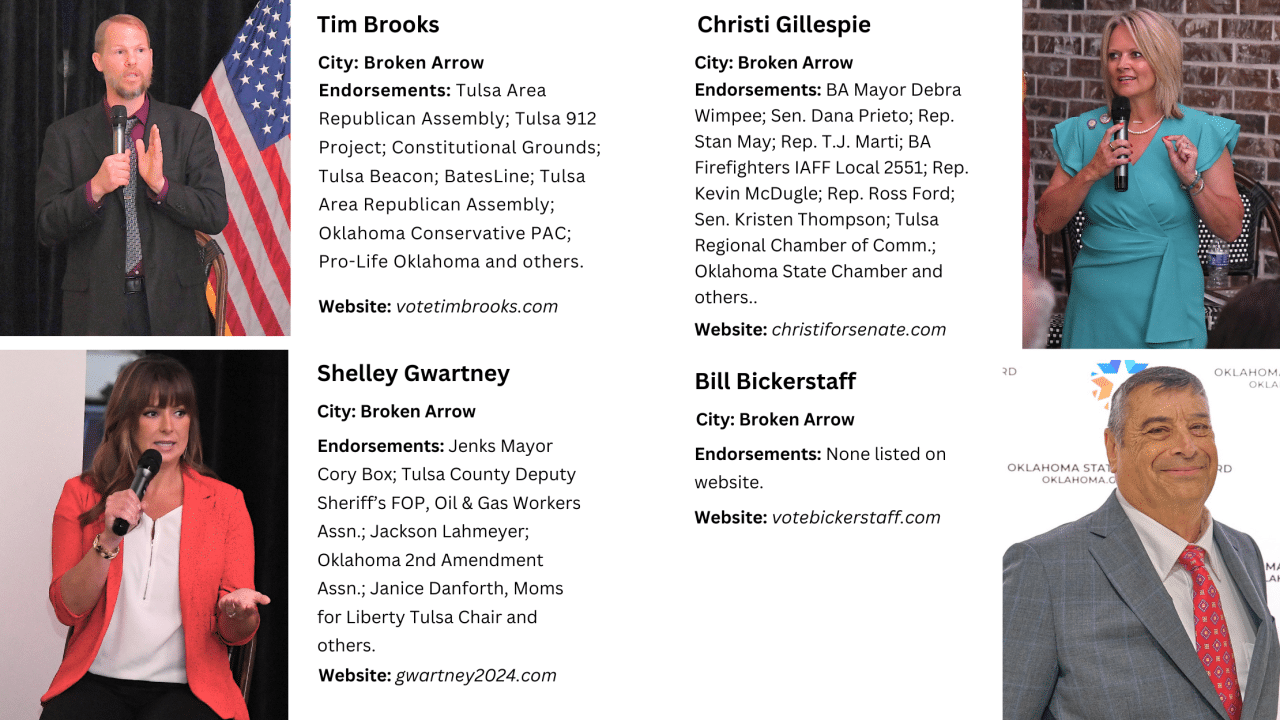
The four official Republican primary candidates are Bill Bickerstaff, Tim Brooks, Christi Gillespie and Shelley Gwartney.
This is the first article of a three-part series that will examine their positions on crucial issues facing the state, from immigration and education to tax policy and tribal relations. Their answers are being shared from a candidate forum recently hosted by Citizens for Liberty of Broken Arrow.
Bickerstaff was unable to attend the event and was unable to furnish answers to questions by the deadline. But more can be found about his campaign here.
If one of the candidates eclipses the 50% threshold on June 18, they will face Democrat Bob Willis in the Nov. 5 general election. If no candidates reach that threshold a runoff election between the top two vote-getters will be held Aug. 27.
Our first article will explore legislative and taxing priorities in Oklahoma. Article 2 to be posted Saturday explores their stances on abortion and Oklahoma’s educational system.
Q: Many lawmakers say they have positions on everything, but you can’t do it all. What topics will you focus on specifically?
BROOKS: The judicial nominating committee. We work hard to pass appropriate legislation that might hold back critical race theory, DEI, and it goes before a very liberal Supreme Court and gets struck down. Who the judicial nominating committee is should be our number one priority. The second topic has to do with our economy. I’m a big supporter of small businesses and making sure our economy is not too permit heavy or tax heavy to startups and small businesses.
GWARTNEY: My passion is the next generation, equipping parents and protecting our children. So that would start with our schools. I’ve worked in public, private and charter schools and helped start Oklahoma’s first and only classical charter school, Tulsa Classical Academy. If it’s in that realm, I’m on board for getting us out of the bottom in the nation for academic.
My family’s experience with (the Oklahoma Department of Human Services (DHS) is going to come out often, having been a foster parent for six years. We have this necessary system of DHS that is not perfect. It’s corruptible and flawed. People run it. So finding the balance of what a legislator could do to hold them accountable and to also spur on things that may make it a better system. We can’t be as strong economy or city if our families are being pulled apart or having their kids ripped away without due process. The system needs more eyes on it.
GILLESPIE: You can have the best school district in the world, but if you’re not a safe city, nobody wants to live there. So public safety is the most important thing. When I talk to people at their doors, every single person talks to me about undocumented people coming across our border illegally. That’s a public safety issue in our state. And we have got to do something about the fentanyl epidemic in our country and in our state, and medical marijuana in our state. When we voted this in, people thought they were voting for some grandma with Parkinson’s needing it to feel better or someone with cancer to not have pain. And what we ended up with is the most liberal marijuana laws in the country. All of this has to do with public safety.
QUESTION: What will be the first bill you write?
GILLESPIE: I’ve gotten to write a bill already. I worked with Lonnie Sims on a campaign finance law that went into effect for municipalities because there’s so much dark money coming through during City Council and school board elections. You can require political action committees to divulge who contributes to them. The tricky thing about it is we have to get three cities to come on board with us to actually implement it. We’re still working on that two years later. If that doesn’t tell you something about dark money in our state, I don’t know what does. Campaign finance is very important to me because people are getting elected due to influence from people outside our state.
BROOKS: One priority would be education. One of the things we have in our law is that no more than 5% of a school budget can go to administrative costs. Over 50%, almost 53% of Tulsa Public Schools’ budget goes to administrative costs. So how is it that they skirt the law? We have fewer teachers than non-teachers. If you take the budget and divide it by the number of students, each student could receive $20,000 for their education per year. You could hire an individual tutor for each student. And yet we have failing institutions. Less than 16% of our third graders can do math, less than 14% can read. If I was going to pass a law it would be to rein in public school systems and eliminate their ability to hire contract workers and make them follow the rules applied to all of public education.
GWARTNEY: I was hoping it wouldn’t have to be moving the school board elections, but that didn’t get done this year so that’s still going to be on the table. One thing I’ve seen and heard from constituents in our schools and in their workplaces is the cancer that DEI is. It is brainwashing our children and creating little social justice warriors in our public schools. I’m not sure what’s being done to protect our people and their jobs. I have now heard from two people who own liquor stores who were told that they cannot give discounts to the people they want to give discounts to – our veterans. How are we restricting small businesses like that? I would do whatever I can to abolish DEI in our state.
Q: The state Senate has had differences of opinion with the Republican-controlled House and Governor Stitt on issues like tax cuts, the budget, and even education reform. Do you think this divide is healthy government, or should everyone be on the same page?
GILLESPIE: I don’t think it’s healthy government. In my business career and just in general, I’m about building relationships. Right now, I have wonderful relationships with House representatives and I look forward to working with them toward crafting bills and not making everything a fight. I will always reach across the aisle and talk to my fellow Republicans and the governor.
GWARTNEY: I don’t think expecting everyone to be on board with everything is productive. We probably agree on 80% of it and that should be enough to move the ball forward. The people that are bought and paid for will be really hard to get on your side. What we can do is know that when we get into office, we’re not going to sell out. We understand that it’s important to get every side of every issue before you make your decision. But I don’t think it’s healthy to just say that every Republican should be on the same page across the board. I think you have healthy discussions and the differences in that 20% will help us get the best bill.
BROOKS: What is healthy is the slow pace of legislation. The government is designed in such a way that legislation should not move quickly. It should be studied, debated and pored over so the laws we make don’t need to be amended later. What is unhealthy is the amount of disrespect and dishonor that goes on between the House and Senate. When a bill goes through the House, moves over to the Senate and it goes through committee, it is incredibly disrespectful not to let it get a vote in the Senate.
Q: Gov. Stitt has continued to point to Texas as one of the states we should be like when it comes to everything from taxes to regulations. Should Oklahoma be more like Texas?
GILLESPIE: I’m glad we passed the recent grocery tax decrease. We have to reduce the income tax for those that at incomes of $27,000 or below. We absolutely can eliminate the income tax for them. We have a rainy-day fund right now that will pay for that. Also, I would cap property taxes for those 65 and over. But starting with that lower income level for eliminating the income tax, and then gradually reaching the point where we can eliminate the income tax altogether would be my vote.
GWARTNEY: We should look at states and see what’s working for them and why it’s working for them. Is there a different demographic? Are there different groups with the products they produce? What’s the closest thing that we could reproduce in Oklahoma? Some of these states have raised property taxes and I’m not a fan of that. When you talk about people who are on disability and not working or retired, I don’t want to risk their property taxes going up where they can’t pay and lose their houses. But let’s look at every state and see how they’re doing it because that’s how you make a well-rounded decision.
BROOKS: I do not want to be like Texas. I do not want to be like Kansas. I do not want to be like Missouri. I want Oklahoma to be the leader. We saw this a little bit through COVID. Other states were standing up and we were dragging our feet waiting to see what they did. We have a golden opportunity with a super majority in the House and Senate and control of the governorship. We should be Exhibit A. They should want to be like us. There’s a lot of work that we can do in taxes. Just cutting taxes without tax reform creates long-term liabilities.



Tim Simmons says
It’s interesting how Gillespie says she’s concerned about “dark money” when she has received 10’s of 1,000’s of dollars in dark money in her campaign. I’d be really interested to see her explain where all that money came from. And then, we still have her comments (on video) about the 1st amendment not being a protected right. Good gosh I hope people are paying attention.