By John Dobberstein, Editor
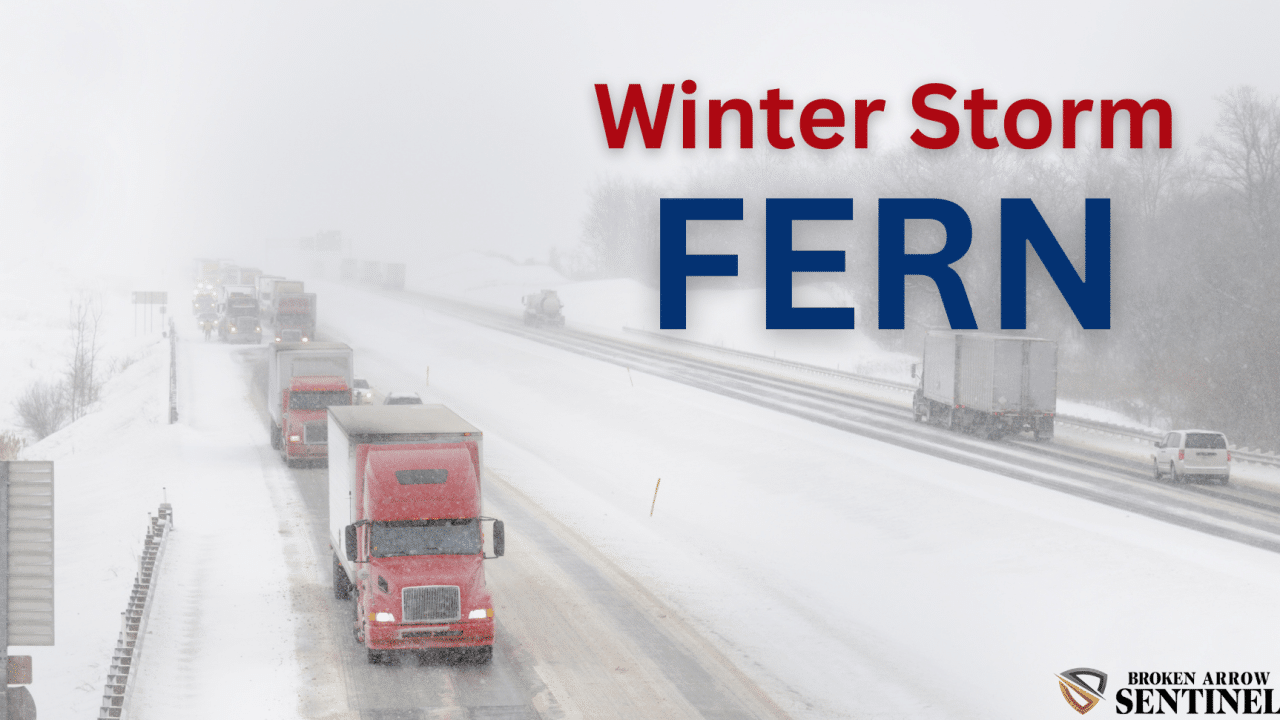
Broken Arrow and vicinity will be facing a major winter storm this weekend poised to disrupt daily life across the state for several days.
A winter storm warning has been posted by the National Weather Service for the Tulsa metro area and much of eastern Oklahoma, as the forecast is calling for Winter Storm Fern to drop 6-12 inches of snow north of Interstate 40, and blowing and drifting of snow may occur as well. South of I-40, mainly sleet is expected, mixing with snow and freezing rain, with total sleet and snow accumulations between 3-5 inches.
The NOAA office in Tulsa says roads will become dangerous for travel or be impassable at points. Widespread road closures are expected, including major routes.
Behind the storm, bitter cold will flow into the region Friday night into Saturday, dropping wind chills during the weekend from -5 to -15 degrees F.
BROKEN ARROW
The city of Broken Arrow began pre-treating some roads on Wednesday ahead of the storm. More details about storm preparations in Broken Arrow are forthcoming.
Also to note in Broken Arrow: On Friday, January 23, trash and recycling will be collected together in one route and taken to the landfill to provide crews more time to complete Friday’s service before the winter weather hits the area. Bags of trash placed outside the carts will not be picked up. If you prefer that your recyclables do not go to the landfill, please do not set out your blue recycling cart.
The Broken Arrow Fire Department plans to increase staffing levels and deploy additional resources in response to the storm.
BAFD will staff four additional units from Friday through Sunday, with the capability to add three more units if conditions worsen or call volume increases. Extra resources will be strategically positioned throughout the city to ensure timely emergency response.
As weather conditions deteriorate, BAFD urges residents to remain indoors as much as possible. Slips and falls are the most common emergency calls during winter weather events, and hazardous road conditions may lead to delayed response and increased hospital transport times.
“Our crews are trained and prepared to respond, but the best-case scenario is to prevent emergencies from occurring,” Broken Arrow Fire Chief Jeremy Moore said. “If the weather deteriorates, we encourage everyone to stay home and indoors unless necessary to go outside.
“So many of our citizens get injured by just going to the mailbox or running to the store. We encourage everyone to prepare now, so they don’t need to go out.”
With wind chills expected to drop below zero, residents are encouraged to practice safe heating and fire prevention measures, especially in the event of a power outage. Generators should always be operated outdoors to prevent carbon monoxide exposure, and only approved heating devices should be used in accordance with manufacturer recommendations.
The Broken Arrow Fire Department is in close communication with its mutual aid partners and will coordinate responses as necessary to ensure continued service and public safety throughout the storm.
On Monday, January 26, trash and recycling services will be suspended out of an abundance of caution for the safety and well-being of our employees. Services will slide to the following days this week: Monday service to Tuesday, Tuesday service to Wednesday, Wednesday service to Thursday, and Thursday service to Friday.
“Due to the frigid temperatures and the anticipation of the residential roadways being snow packed, we will again run only one route to collect both trash and recycling together. Again, if you do not want your recyclables to go to the landfill, please do not set out your blue recycling cart. Bags of trash placed outside the carts will not be picked up,” city officials said.
“We understand these changes are not ideal, but we appreciate your understanding as we do our very best to provide you with uninterrupted service and ensure our Solid Waste and Recycling employees can safely perform the duties of their job during this upcoming winter weather storm.”
COWETA
City of Coweta Public Works crews are monitoring conditions and preparing to clear and treat roadways to support safe travel and emergency access throughout the community. Public Works will begin plowing roads once snowfall reaches approximately 1 inch. This helps prevent damage to both road surfaces and equipment.
Priority routes will include:
- East–west arterial roads leading to Hwy. 51: Oneta/101st, 111th, 121st, 131st, 141st, and 151st
- Broadway from 151st Street to Hwy. 51 to ensure access for the Coweta Fire Department and Police Department
- North–south collector roads running from 273rd Street to 305th Street will be plowed simultaneously.
- After plowing, sand and salt will be applied to intersections to improve traction.
Important safety reminders:
- Please stay at least 200 feet behind a moving snowplow
- Avoid driving during wintry conditions unless absolutely necessary
- Public Works crews will be working 12-hour shifts throughout this weather event
Please note that Hwy. 51 is a state highway and is maintained by ODOT.
City of Coweta Public Works is working closely with the Coweta Police Department, Coweta Fire Department, and Wagoner County Emergency Management. If emergency access is needed on any roadway, crews will assist as required.
TULSA
City of Tulsa Public Works crews are closely monitoring forecast updates and preparing for winter operations.
- Crews will begin treating roadways with brine as early as Thursday night, depending on the timing and type of precipitation. If rain precedes winter precipitation, brine may not be used.
- Once the response starts, crews will be on 24-hour operations, working 12-hour shifts throughout the duration of event.
- As conditions warrant, crews will transition from pretreatment operations to plowing and continuous snow response efforts.
Residents should remember that during winter storms, road conditions can remain hazardous regardless of treatment efforts. If you see City plows or treatment vehicles, keep your distance and never attempt to pass them while they are working.
The city of Tulsa is responsible for all clearing snowand ice from:
- All arterial (main) streets, including bridges, hills and overpasses
- Gilcrease Expressway (excluding the Turnpike section)
- L.L. Tisdale Expressway
Other highways (i.e. 169, Broken Arrow Expressway, I-244, Creek Turnpike) are maintained by the Oklahoma Department of Transportation. Additionally, Tulsa’s neighborhood streets are generally left untreated (excluding hospital access streets) due to the focus on main roads and emergency routes.
For a complete list of the city’s assets to combat winterprecipitation, in addition to a map of the City’s snow and ice routes, visit: www.cityoftulsa.org/winterpreparedness.
Beginning Thursday, Tulsa County Highway District crews were to begin preparing for anticipated winter weather by installing plows and sanders on trucks and pretreating bridges and known trouble spots.
On Friday morning, crews will continue pretreating bridges and priority areas. Plowing and sanding operations will begin as snowfall develops.
Road treatment operations will continue throughout the weekend and into Monday or Tuesday, as needed, with crews working rotating shifts until roadways reach acceptable driving conditions.
TULSA COUNTY
Tulsa County’s winter response capabilities include 15 trucks with salt spreaders and snowplows, 3 liquid applicator (LAS) brine trucks, 1 motor grader for plowing, approximately 6,000 tons of salt, and 2 brine mixing systems holding 6,000 gallons of brine, all available should conditions worsen.
As a reminder, Tulsa County’s road treatment priorities are available to the public at:
www.tulsacounty.org/gis
- For basic services such as food, clothing, shelter, transportation, and more, residents can call 211 or visit: https://www.211oklahoma.org/
- Power outages can be reported on PSO’s website at https://www.psoklahoma.com/outages/report or 1-833-776-6884.
- Conditions of Oklahoma highways can be monitored at: www.okroads.org
RESOURCES FOR HELP
Homeless Outreach & Shelter Operations
The City of Tulsa, in coordination with the A Way Home for Tulsa Continuum of Care (AWH4T), Housing Solutions, and local shelter partners, is ramping up efforts to protect vulnerable residents during this dangerous cold period.
Outreach teams will deploy throughout the city to move individuals experiencing homelessness into shelters and out of life-threatening conditions. Metro Link Tulsa is partnering with Housing Solutions Tulsa to offer shuttle service to emergency shelter locations.
Winter Weather Shelters (Open 24/7)
The following shelters will be open 24/7 during this weather event. Pets are accepted where noted.
- John 3:16 Mission, 506 N. Cheyenne Ave.
- Salvation Army Center of Hope, 102 N. Denver Ave.
- Tulsa Day Center, 415 W. Archer St.
Pets accepted (limited capacity)
- CREOKS Winter Shelter (new winter weathershelter), 7216 E. Admiral Blvd.
Pets accepted
Capacity 250 (from Friday – Sunday night)
- Tulsa Dream Center West (emergency shelter), 4122 W. 55th Pl.
Pets accepted
Capacity 150 (from 2 p.m. Friday – Sunday night)
AWH4T and Housing Solutions will work with each shelter to assess needs and capacity. City/County emergency management operations will work in close coordination with shelter providers and partners throughout the duration of the event.
Metro Link Tulsa will offer free fair service on Saturday and Sunday pending ability to operate service.
TIPS FOR WINTER STORM
1. Charge all phones, power banks, tablets, and rechargeable lanterns.
2. Fill vehicle gas tanks in case stations lose power.
3. Get cash in small bills in case card systems go down.
4. Pick up prescriptions and essential medications early.
5. Download movies, books, and maps for offline use.
6. Identify one warm room in the house to “camp out” if power fails.
7. Locate water shut-off valve and breaker box now, not later.
8. Set fridge and freezer to colder settings to hold temperature longer.
WATER AND PIPE PROTECTION
9. Drip faucets on exterior walls when temps drop below freezing.
10. Open cabinet doors under sinks to allow warm air circulation.
11. Disconnect garden hoses from outdoor spigots.
12. Cover outdoor faucets with insulated caps or towels.
13. Know how to shut off water quickly if a pipe bursts.
14. Fill jugs, buckets, or bathtub with water for flushing and washing.
FOOD AND KITCHEN PREP
15. Keep 3–5 days of NO-COOK food like peanut butter, tuna, bread, crackers, canned meat, fruit cups, cereal.
16. Have manual can opener available.
17. Buy shelf-stable milk or powdered milk if needed.
18. Freeze a few water bottles to act as freezer “ice packs.”
19. Keep a cooler ready to move fridge food outside if power is out and temps are below freezing.
20. Avoid stocking large amounts of perishables right before the storm.
HEAT AND HOME SAFETY
21. Gather extra blankets, sleeping bags, and warm layers.
22. If using a fireplace, confirm chimney is clear and have dry wood.
23. Never run generators or grills inside garages or homes.
24. Test smoke and carbon-monoxide detectors.
25. Have at least one flashlight per person plus spare batteries.
26. Use battery lanterns instead of candles when possible.
VEHICLE AND TRAVEL
27. Plan to avoid driving once freezing rain begins.
28. Bridges, overpasses, and shaded roads freeze first.
29. Keep in the car: blanket, water, snacks, phone charger, gloves.
30. Replace old wiper blades and top off washer fluid.
31. Park away from large tree limbs when possible.
32. Assume flights and travel may be disrupted.
POWER OUTAGE PLAN
33. Unplug sensitive electronics to avoid surge damage.
34. Keep one battery radio or weather app for updates.
35. Use surge protectors for TVs and computers.
36. Know where warming centers may be in your area.
37. Have extension cords ready if using a generator outside.
38. Keep refrigerator closed to preserve cold air.
PETS AND LIVESTOCK
39. Bring pets indoors with extra food and water.
40. Provide outdoor animals with unfrozen water sources.
41. Add straw or blankets to outdoor shelters.
42. Keep leashes and carriers accessible in case of evacuation.
MEDICAL AND SPECIAL NEEDS
43. Keep a written list of medications and dosages.
44. Store a small first-aid kit with thermometer and basic meds.
45. Have backup batteries for medical devices.
46. Identify a place with power you could relocate to if needed.
PROPERTY PROTECTION
47. Move vehicles away from trees or power lines.
48. Secure outdoor furniture and lightweight items.
49. Avoid trimming trees during the storm, do it beforehand.
50. Photograph property for insurance before conditions worsen.
DURING THE STORM
51. Do not drive unless absolutely necessary.
52. Assume downed lines are live and dangerous.
53. Use only safe indoor heating methods.
54. Check on neighbors, especially elderly, by phone if possible.
55. Report outages to utility companies rather than 911 unless it’s an emergency.
AFTER THE STORM
56. Walk carefully, ice may refreeze overnight.
57. Check pipes for leaks as temperatures rise.
58. Throw out refrigerated food if above 40°F for more than 4 hours.


Leave a Reply