By John Dobberstein, Editor
As two families mourn the tragic deaths of autistic children who wandered away and died, the U.S. Department of Health and Human Services on Sunday unveiled the first-ever alert for missing and endangered autistic persons.
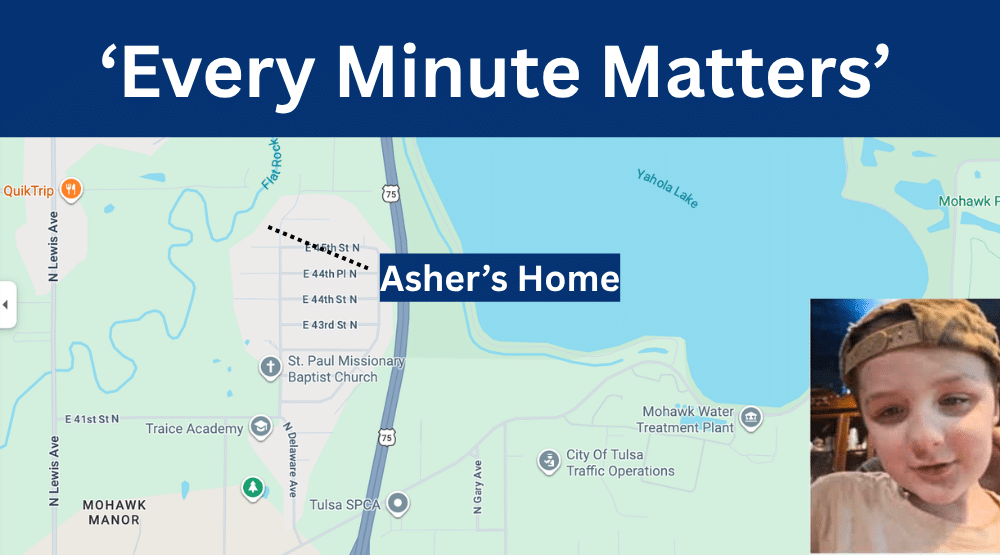
Asher Judkins, a 7-year-old autistic boy, left his home near 45th Street North and North Delaware Avenue around 2 p.m. on Aug. 20. The Tulsa Police Department estimates the family called 911 about an hour after the boy had likely left.
A massive search rapidly ensued with helicopters, drones, boats, search dogs and more than 150 first responders. In addition to TPD, EMSA and the Tulsa County Sheriff’s Office assisted in the search.
Unfortunately, Tulsa firefighters found Ashton’s body at about 8 p.m. near a creek, a few blocks from where he was last seen. The Oklahoma State Medical Examiner has jurisdiction over the investigation of Asher’s death. Police declined this week to release any preliminary findings in the case.
“Our deepest condolences go out to the child’s family and everyone who knew and loved him,” TPD said in a statement.
As the investigation continues, the Department of Human Services took the couple’s other 3-year-old boy into custody.
The boy’s mother, Sarah Judkins, told KOTV that she was preparing a bath for Asher that afternoon and that’s when the boy likely walked away from the home. She and her husband, Chris, said they’ve dealt with the behavior before but were always able to catch Asher before he got out of the yard.
Sarah Chorn is raising funds through GoFundMe to help Sarah and Chris pay for the child’s funeral, pay for legal fees that may be required to bring their other son home, and potentially repair their home or move so they can meet state requirements.
“In the span of a single day, this family lost so much and their world was turned upside down,” the fundraiser page says. “Shelby and Chris are doing everything they can while already living with financial hardship, and now they are carrying burdens no family should have to face alone.”
“Asher was a lovely, energetic boy who brought life, light, and laughter to his family. He was a bright star, a ray of hope, and the beating heart of his parents.”
It was the second drowning of an autistic child in the Tulsa metro in 2 months. On July 8, a 4-year-old child wandered off at the Carlyle Apartments in Broken Arrow. In spite of a massive search by first responders she was found dead at the apartment complex’s pool.
On Sunday, HHS Secretary Robert F. Kennedy Jr. announced the development of the first-ever National Autism Missing and Endangered Person Alert initiative.
Led by HHS in partnership with the U.S. Department of Justice (DOJ) and the Federal Emergency Management Agency (FEMA) under the Department of Homeland Security (DHS), the initiative will work to strengthen coordination among emergency management agencies, law enforcement, first responders, and community partners nationwide to improve preparedness and response when autistic individuals are reported missing.
It will also establish a national framework of best practices to address the leading causes of preventable injury and death among autistic individuals, which include accidental drowning linked to wandering and elopement.
“When an autistic child or adult goes missing, every minute matters,” Kennedy said. “We are bringing federal, state, and local partners together to improve prevention, speed the response, and help bring autistic children and adults home safely.”
According to HHS, about half of autistic children engage in wandering behavior at some point. A pediatrics study found that 49% of children with autism had attempted to elope at least once after age 4.
The National Autism Safety Council reports that an average of eight autistic children die each month in the U.S. following wandering or elopement, most often from drowning in nearby water.
Drowning accounts for the majority of autism wandering fatalities, and many missing individuals are found close to their last known location. Rapid action—including searches of nearby water sources and other high-risk areas—can be critical.
For more information, visit www.hhs.gov/autism.




Leave a Reply