
By John Dobberstein, Editor
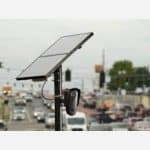
By law enforcement measures, ALPR (automated license plate recognition) technology used in Flock, Leonardo, Axon and other surveillance cameras are a crime-fighting tool that has helped police located stolen vehicles, apprehend violent crime suspects, find runaways, clear homicides and more.
But to those who interpret the Fourth Amendment to its strictest standards, the cameras and retention of their data amount to warrantless mass surveillance of the population. The controversy has put many municipalities on the spot.
In Coweta, Police Chief Michael Bell contacted Flock Safety a week ago to request the removal of Coweta’s two Flock cameras and to notify the company that Coweta would not be renewing the Flock Safety contract.
“The decision not to renew was based on ongoing citizen concerns regarding Fourth Amendment rights,” Bell said in a statement.
In Oklahoma City, the City Council is expected to vote soon on whether to extend its contract with Flock Safety, according to an article in the Sooner Sentinel. The City Council is expected to visit the issue again Tuesday.
And in Broken Arrow, which has invested heavily in its Real Time Information Center (RTIC), the Broken Arrow Police Department said it does not own or operate any Flock cameras, but there are Flock cameras throughout Broken Arrow that are privately owned and operated by retailers, homeowners associations and other agencies.
The Associated Press reported that Flock CEO Garrett Langley announced some optional guardrails for the technology will become mandatory for users by Jan. 1. All law enforcement customers will have to implement an audit tool that’s intended to flag abnormal search behavior, and Flock is also shortening the standard data retention window from 30 days to seven, AP reported.
Flock said it will allow data to be preserved for longer when it is evidence tied to a case number.
Investing in policing
BAPD spokeswoman Hannah Perry said the department does have a contract with Flock Safety that provides authorized officers access to information available through the Flock network, “for legitimate law enforcement purposes and in accordance with department policy.”
She noted that Flock technology isn’t exclusive to government or law enforcement, as private organizations also utilize the technology as a security tool to help protect businesses, neighborhoods and other assets.
“Owners of participating Flock cameras are aware of and authorize the law enforcement access associated with their participation in the network,” she added. “This allows information from participating cameras to be available to authorized BAPD personnel when there is a legitimate law enforcement need.”
The Sentinel has covered some stories where Flock assisted officers in locating a missing Broken Arrow juvenile, and in apprehending a suspect in an attempted vehicle burglary and shooting.
Perry notes there is a “significant investment” being made in bringing policing into the 21st century and providing officers with technology that can help them respond more effectively and solve crimes.
The issue was also covered in a Sentinel article about the RTIC. At a City Council meeting where the RTIC was being discussed, some expressed concerns about privacy rights and data security, with the potential for it to fall into the wrong hands or be misused.
The city opted to store all its video data on 6 camera servers in-house rather than outsourcing data storage to the cloud. “We don’t have any plans on doing anything else,” BAPD Capt. Brandon Tener said. “We’ll always hold our own video data.”
The city’s LPR camera data is currently stored through Leonardo ELSAG servers in Houston, although the city plans to bring that data in house as well, utilizing SD cards in each camera so the voluminous amounts of data from the 4K cameras doesn’t have to be sent back to the cloud.
Tener says the city and police department understand concerns citizens have about their data and a policy is being developed that defines what BAPD can or can’t do. Among other things, the department is currently choosing to not use facial recognition.
The department said last May that nationally, 76% of police departments with a population between 100,000 and 249,000 use LPR technology. Broken Arrow’s population is 122,000.
“Yes, we’re going to have a lot of lenses in the city. We’re going to read tags in the city. People are used to the fact that given the justification we can look at their driver’s license record and find pertinent information out, but a social security number is very sensitive information. We have to have justification to do that.
“The same thing is going to apply here. We can’t just randomly start running people’s tags through the LPR system to see what they’re doing. We’re going to have policy that mandates that. There’s a huge investment here in stepping into the 21st century with policing. But there’s going to be the same checks and balances as with anything else that’s sensitive.”
“BAPD has policies governing the use of this technology, including who is authorized to access it and the purposes for which it may be used,” reiterated Perry. “As with other sensitive law enforcement systems, checks and balances are in place to ensure the technology is being used appropriately and for legitimate law enforcement purposes.
“These systems are tools to assist officers. They can provide investigative leads, help locate missing or wanted individuals and give officers additional information during an investigation, but they do not replace the investigative process or the responsibility to verify information.”
Mass surveillance ahead?
A recent article in the Sooner Sentinel by Chief Editor Marven Goodman — who served the Adjutant General of Oklahoma as his Chief Information Officer for the Oklahoma Military Department — described what many Fourth Amendment hawks fear about Flock and ALPR technology.
Despite running 90 Flock cameras across Oklahoma City, police don’t offer a public dashboard, audit log or transparency portal where citizens can see who is searching license plates or why. Mapping from the “DeFlock OKC” project shows approximately 300 Flock cameras across the broader Oklahoma City metro. DeFlock OKC is part of a national “DeFlock” movement.
“Flock markets these AI-enabled cameras as simple license plate readers, but that description is misleading,” reported Goodman, who established the first wide-area network connecting all Oklahoma Army National Guard armories enabling modern file sharing and email.
“These systems capture far more than license plates, they record vehicle make, model, color, and distinguishing features, then store that data in a corporate database that can be accessed and searched with no external oversight. What has been installed across this city is not targeted law enforcement technology; it is mass surveillance infrastructure that treats every Oklahoman as a potential criminal subject of interest.”
Goodman also reported this month that state legislation introduced a decade ago that never passed enabled rapid expansion of ALPR use beyond just insurance verification.
“By recent years, Oklahoma ALPR systems generated over a billion plate scans annually in peak periods,” he wrote. “Cameras on patrol cars, fixed poles, and even private tow trucks logged timestamps, GPS coordinates, and vehicle movements. The vast majority — around 99.5% in some analyses, had no connection to any crime or insurance violation.”
The 2025 House Public Safety Committee review led by Rep. Tom Gann documented repeated use “well beyond what the law allows,” Goodman reported. “Data has been applied to general criminal investigations, shared with federal agencies, and retained far longer than necessary for insurance purposes. Court cases have seen ALPR-derived evidence suppressed due to improper collection or use.”
‘Robust auditing systems’
The Frontier reported last year that the city of Tulsa installed Flock cameras despite the fact that state law prohibits the use of license plate readers for any purpose other than the enforcement of the state’s mandatory insurance law.
At the time, the Tulsa Police Department operated 105 Flock Safety license plate readers and over 150 pan-tilt-zoom live-streaming cameras, managed from its Real-Time Information Center. The city held open community meetings about the RTIC and Flock cameras before they were activated.
TPD said recently it has established policies and safeguards, “to ensure appropriate and practical use of all our ALPRs. Use of ALPRs is restricted to “authorized users” conducting official police business. TPD said its setup has “robust auditing systems that misuse and enable us to hold unauthorized users accountable.
“Any time an officer utilized a Flock/ALPR camera they are required to list the reason for their search, as well as the associated case number. Flock includes an automated auditing system that will alert the department to any anomalies or abnormal use.”
Despite skepticism in some cities about crime decreases, TPD said in the RTIC’s first year of operation larcenies of motor vehicles were down 43% in the Tulsa area, no AMBER alert has lasted more than an hour, “and it has revolutionized our response to missing persons.”
Additionally, the department said the RTIC and associated technology has been used in about a third of homicide cases, and it’s directly led to the recovery of more than $4 million in personal property.




Leave a Reply