By John Dobberstein, Editor
Since the city of Broken Arrow announced in December it may look at the feasibility of building a general aviation airport, social media has been awash with comments, mostly from those opposing the idea.
Nevertheless, the city posted a request for proposal for firms to conduct the study, which will cost taxpayers approximately $150,000. The winning bidder and potential study contract could be presented before the Broken Arrow City Council next month. If a study is approved, it would take a year to complete the study.
The city says its focus is exploring a small airport — not commercial aviation — to host small private planes and corporate jets and support local business and industry. The city completed a similar study in 1980, but Broken Arrow’s population has quadrupled since that time.
The new study, if authorized by the City Council, would include a forecast of aviation activity in the region, recommended development plan, review of general site areas, grant evaluation and a final report and recommendation.
City Manager Michael Spurgeon says Broken Arrow business leaders, current and former state and federal elected officials, businesses that own planes and private pilots have asked why the city of its size doesn’t have an airport.
Spurgeon believes development will continue in east Tulsa and Wagoner County, and someday a bridge will be built to carry vehicles over the Verdigris River at 71st Street. Two locations that the earlier feasibility study suggested for an airport have already been developed.
“At the pace we’re growing for residential, commercial and manufacturing development, land available now may not be in 20 years,” Spurgeon told the news station.
Local businesses and even the soon-to-be-open Regent Amphitheater could use a Broken Arrow airport, rather than going to Tulsa International Airport or Tulsa Riverside Airport, Spurgeon says. Spurgeon notes he’s spoken with local pilots who are parking planes as far as Northwest Arkansas because there is a waiting list to get hangar space at other airports that meet their needs.
“Our responsibility is looking at today and tomorrow. And there should be some public discussion about why it’s important,” Spurgeon told Fox23 in a recent interview. “We’re not buying land or breaking ground, and planes will not be flying anytime soon.”
Another area the study would look at is governance. A potential airport could be operated by the city, or an appointed board with an airport manager, or some other model. A master plan for the airport would also have to be drawn up.
Another question centers around timelines if an airport moves forward. If the city placed a bond issue before voters, it could be as late as 2036 before voters weigh in. If a private airport is planned and the land is acquired, it could be a little sooner. An airport with an FAA permit would have to go through a host environmental and safety studies that would take years.
Economic impact of airports
It’s no surprise that many associations and governments support development of general aviation facilities. But there have been very few new airports built in the U.S. in the last 25 years.
The most recent “greenfield” airport built in the U.S. from the ground up is Gallatin County Regional Airport in Sparta, Ky. The 650-acre airport, which opened in 2023, has a 5,000-foot runway and cost $44 million, which included $26 million in federal funding and $18 million in state money. The facility doesn’t have hangars or a terminal yet.
The airport was first proposed in 2004 and is meant to provide service for business along the I-71 corridor between Louisville and Cincinnati. Kentucky Department of Aviation Commission Mark Carter told WVXU a flight school was a possibility, and it could even be used in the future for unmanned aircraft such as last-mile drone deliveries.
A study from the National Business Aviation Assn., in conjunction with several other organizations, released last year found general aviation in Oklahoma generated 5,700 direct jobs, 11,500 indirect and “induced” jobs, and 18,800 total jobs, resulting in 0.8% of the state’s employment, slightly higher than the U.S. average. The same study found the airports here contributed $1.3 billion in labor income.
GENERAL AVIATION
AIRPORTS IN TULSA METRO

Source: Alliance for Aviation Across America
The Alliance for Aviation Across America says general aviation airports within a 100-mile radius of Broken Arrow — including Arkansas, Oklahoma and Kansas — employ more than 5,700 people, bring $260 million in payroll and generate an economic impact of $1.1 billion.
In Oklahoma, there are 135 public-use airports that serve 9,778 pilots and 6,063 registered aircraft. A 2017 economic impact study by the Oklahoma Aviation Commission found publicly-owned general aviation airports in the state support 6,300 jobs and $270 million in annual payroll, with $693 million in annual economic activity.
Although many critics of the airport idea don’t believe Broken Arrow is a big enough market, smaller suburban cities in the Tulsa metro area already have them: Sand Springs, Wagoner, Skiatook and Claremore.
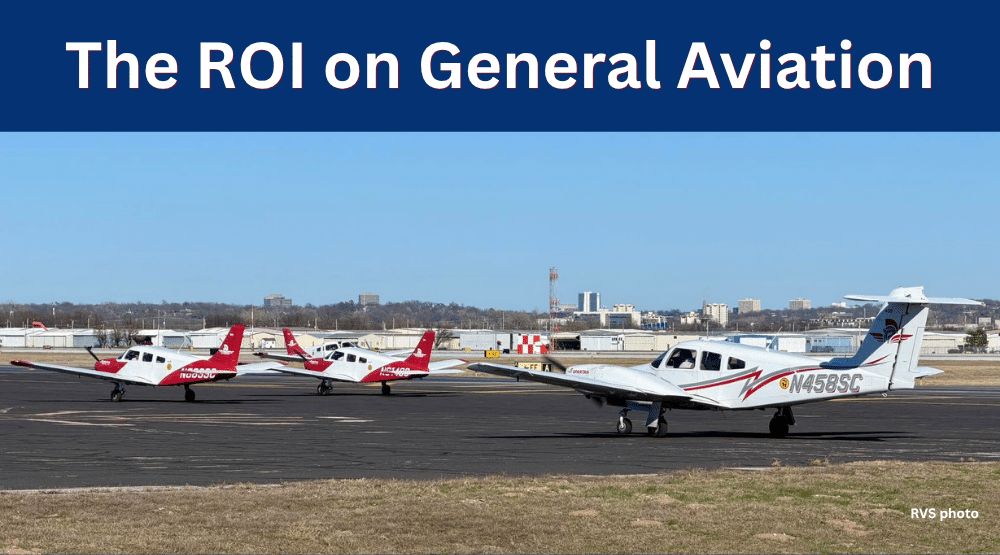
The poster child for successful general aviation airports would be Tulsa Riverside Airport just north of Jenks, which is the busiest airport in the state.
The Oklahoma study found RVS provided 545 direct jobs, 340 indirect jobs, $35 million in direct and indirect payroll, $59 million in total spending, and $94 million in direct and indirect spending due to RVS — along with $4.7 million in annual state and local tax revenues.
In addition to private planes, RVS is used daily by energy companies such as Laredo Petroleum, Unit Corp. and Ventana Exploration & Production to access oil wells, drilling sites and regional offices.
Many of these companies also have vendors and suppliers such as Lariat, Paragon Industries, Asphalt & Fuel Supply, BRG Energy and White Buffalo Environmental that use the airport to support their area operations.
Del Aviation, a Tulsa-based company, also provides air patrol of pipelines and transmission power lines from the airport. These airport-supported employers and activities are important to many area jobs.
RVS supports missions conducted by the Veterans Airlift Command, which provides free air transportation to wounded veterans and their families, and it also supports the area’s healthcare needs via Angel Flight Oklahoma, Tulsa Life Flight and Eagle Med
There are other examples of municipal or regional airports in suburbs, including Kansas City Lee’s Summit Regional Airport, which has 63 employees, $1.9 million in payroll and a $9.2 million economic impact.
In addressing comments about the airport issue recently on Nextdoor, Assistant City Manager Kenneth Schwab notes there have been private airports in the city limits as late as the 1980s, one of which being on 51st Street (the old Cotton Field) and another immediately west of Tulsa Community College South on 81st Street.
“(The study) very well could show that our opportunity for this potential transportation mode has passed our community by. It could show that the need is still there and the business model may work specifically if there are corporate partners,” Schwab wrote.
“This is exactly the point of a study. Honestly, it is good government in action when your leaders are looking to your future not stuck in the moment.”




Leave a Reply