By John Dobberstein, Editor
When it comes to population growth in the Tulsa metropolitan area in the last several years, the south suburbs — including Broken Arrow — are leading the way, while the city of Tulsa is adding residents at a much slower rate.
That’s according to the latest population estimates from the U.S. Census Bureau released recently, which show what’s happening in Tulsa resembles national trends.
Since 2020, city centers of many major U.S. metro areas have had sluggish population gains, with some places even declining. But where growth did occur, it was mostly on the outer edges of metro areas.
TULSA METRO POPULATION GROWTH, 2020-25
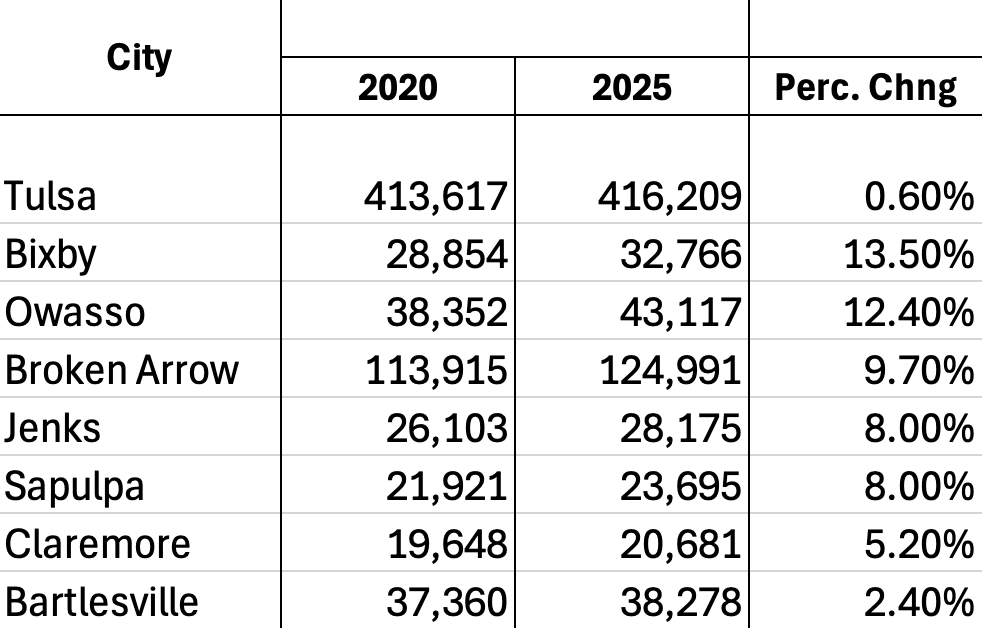
With a population of nearly 125,000, Broken Arrow has grown by 9.7% since 2020, the year of the pandemic, and BA is the fourth-largest city in Oklahoma — behind only Norman, Tulsa and Oklahoma City. Broken Arrow is growing at 1-2% per year, which is a healthy rate.
For cities 20,000 or larger, Bixby posted the highest overall growth over the period at 13.5%, followed closely by Owasso at 12.4% and Broken Arrow. Jenks and Sapulpa (8%) also posted strong gains, while Skiatook (5.5%) Claremore (5%), Sand Springs (2%) and Bartlesville (2.5%) posted very modest gains.
The city of Tulsa, with a population of 416,000, is the 48th largest city in the U.S., but its population has only grown 0.6% since the pandemic.
That pales in comparison to Oklahoma City, which has a population of 719,000 and sits as the 21st largest U.S. city. OKC has grown by 5.4% since 2020. According to Census figures, the city of Norman has only grown 2% since 2020 for a population estimate of nearly 131,000, while Edmond’s population, estimated at just over 100,000, has increased 6% over the period.
The suburbs of Mustang (18%) and Yukon (16%) have led growth in the metro, while Del City and Midwest City have remained largely the same.
The Census Bureau said the country’s fastest-growing places are increasingly likely to be far-flung exurban communities on the outer margins of metro areas, according to July 1, 2023, population estimates released today.
Fewer of the fastest-growing places between 2022 and 2023 were inner suburbs than in 2019 before the pandemic, and more were on the far outskirts of metro areas — 30, 40 and even more than 60 miles away from the largest city’s downtown.
“While the Census Bureau doesn’t define exurbs, we tend to think of them as far outer suburbs of metro areas, and they often have a mix of urban and rural character,” said Luke Rogers, a demographer in the Census Bureau’s Population Division. “Exurbs have sometimes been among the most rapidly growing communities, but this appears to be even more true now than before the pandemic.”
Multiple factors are likely behind the increased growth of exurbs. Among them: Rising housing costs after the start of the pandemic, which drove some people farther away from cities toward exurbs in search of cheaper homes.
Greater opportunities to work from home also likely contributed. Before the pandemic, telework and remote work options were much less common. “With many more people in working ages now able to work from home at least some of the time, it’s likely that some people are more willing to live farther away from their place of employment than they would have in the past,” Rogers said.
OTHER CITIES OF NOTE
- City 2020 2025 Inc/Dec.
- Coweta 9,696 11,472 +18.3%
- Wagoner 7,622 8,405 +10.2%
- Glenpool 13,709 14,705 +7.9%
- Stillwater 49,350 50,046 +3.5%
- Catoosa 7,424 7,471 +0.8%




Leave a Reply