
By John Dobberstein, Editor
The fire chiefs in Broken Arrow and Coweta, both running departments in areas under intense development pressure, said Friday the municipalities are ready to put jurisdictional obstacles aside and provide the best life-saving services they can to those living in unincorporated Wagoner County.
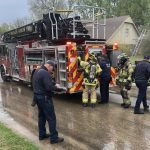
Both Coweta and Broken Arrow city councilors have approved an automatic mutual aid pact that will allow either the Coweta Fire Department or Broken Arrow Fire Department to respond incidents in unincorporated Wagoner County, depending on who had the closest unit.
The city of Coweta will begin paying the city of Broken Arrow monthly for automatic emergency response support in unincorporated Wagoner County under the pilot plan. Because there is an exchange of money between municipalities the agreement must be sent to the state Attorney General’s office for approval.
The two cities recently identified unincorporated areas of the county that are served by each city’s respective fire department. Within the Coweta Fire Department’s response area there are various locations where a Broken Arrow Fire Department response unit may be closer than a Coweta response unit, and vice versa.
For life-threatening medical emergencies and all structure fires, each city had agreed to respond with the closest servicer unit, if available. But neither city was required to dispatch equipment or personnel to an incident that is more than 5 miles from its closest fire station. Although Broken Arrow has fire stations close to the unincorporated areas in question, those residents are technically in the Coweta fire district.
Previously Broken Arrow was providing mutual aid to Coweta informally, in a process that required the fire chief of either municipality to call and get permission to assist during an incident.
Broken Arrow Fire Chief Jeremy Moore said the biggest benefit with the pact is to people who chose to live in unincorporated Wagoner County and have limited, if any, access to any fire or EMS response in their neighborhoods.
“They reap a huge benefit,” he said, because they now have two fire/EMS departments responding to them with the closest and quickest available unit.
“Furthermore, the cost for their service is borne by the two municipalities,” he adds, “while the folks who live in this unincorporated area make no contribution to the property taxes required of the people who live in the city limits of Coweta or Broken Arrow.”
Pocketbook Issues
Many residents living in the unincorporated areas hope the agreement will lead to lower homeowner insurance rates because of the difference in fire protection being provided. Moore said that is a “product of each individual insurance provider’s internal policies.
“Both cities have taken the first step to improve public safety which is also the first step to improve ISO ratings, but several subsequent steps will be required for ISO ratings improvements.”
Any reductions in homeowner insurance rates may take some time to happen. The ISO rating is a system that insurance companies use to determine the cost of homeowners insurance.
Moore said a third-party entity will come in and talk to the fire departments and determine the ratings. The departments have already begun those conversations with the agreement in place.
“Each individual insurance provider has a different metric that they use and they will work with ISO to begin making those changes,” Moore said. “We’ll work with them to not only provide what we’re providing today — the life-saving services — but there may also be a monetary benefit to those citizens in that unincorporated area. It may take some time and we’re working with that independent agency to see if we can bring that to fruition.”
Mandy Vavrinak, a spokeswoman for the city of Coweta, clarified that neither party is required to dispatch equipment or personnel to fire protection or a first-response incident located more than 5 miles from its closest fire station.
“The Coweta Fire Department will continue to respond to fire or medical emergencies within our fire district, regardless of their distance from our fire station, if they are not within the area covered by the aid agreement,” Vavrinak said. “If they are covered, a BAFD crew will respond because they would be, by default, significantly closer to the emergency and have a faster response time.
“The agreement’s purpose is to shorten response times for people in the Coweta Fire District but are significantly closer to a Broken Arrow fire station.”
Both Broken Arrow’s and Coweta’s fire departments have a baseline level of training that is similar across the state, so the departments will now work to connect the dispatch centers so when 911 calls come in Coweta, dispatchers can quickly get the information to a Broken Arrow fire station.
“Once we arrive on scene we already both use the incident command system, and
we will set up a unified command and work together to ensure the safety of
both our crews and the citizens,” Moore said. “We already have common communications for our radios. The next step will be joint training so that we operate efficiently as one team even though we’re two different agencies.”
Dealing With Growth
Wagoner County is seeing a major population boom and that has put stress on fire protection. The Coweta fire district spans 106 square miles but only 10 miles of the district is Coweta’s municipal boundaries.
With a population of nearly 90,000 now, Wagoner County has added nearly 30,000 residents since 2000, which has not only put pressure fire departments but also taxed the resources of school districts and city planners.
In the last 5 years, the Coweta Fire Department has seen a 30% increase in calls, driven by increased population. Over the same period, calls per shift have increased from 4.5 to 5 calls per shift to 8 to 9.
Coweta Fire Chief Brian Woodward said his department ran about 180 calls last year in the area that the agreement covers, which includes about 4,500 residents.
The city is planning to build a fire station on the west side of town once land is acquired and money can be found to build the facility. The population density hasn’t reached the point where more commercial business will come in to increase tax revenue to help pay for services.
“We want to provide for our own citizens so we hope the (Coweta City Council) and the city moves forward with Station 2, and we hope we can staff it,” Woodward said. “And we hope we can get where we can reciprocate and pay (Broken Arrow back for when they need us to be there for them and be part of their team and not just receiving.”




Leave a Reply