
By John Dobberstein, Editor
The city of Broken Arrow and City Council have agreed on the early priorities for the $415 million General Obligation (GO) Bond program approved by voters earlier this year.
Just because voters approved 6 propositions for that much money doesn’t mean it’s all available to spend next year. That wouldn’t be possible without a substantial increase in property taxes.
Because the city of Broken Arrow’s net assessed valuation continues to increase, however, due to continued residential and commercial permitting — which gives the city some additional potential revenue when property taxes are levied each year.


Broken Arrow’s valuation has increased from $750 million for 2015 to $1.1 billion in for 2022 and $1.3 billion for 2024, which was aided by $11 million in new commercial and industrial value added that year.
Assistant City Manager Kenneth Schwab noted Oklahoma is the only state left in the U.S. that doesn’t allow sales taxes to be used for capital improvements.
The city has looked at the projected money to be available through bond sale for each year for the next decade, and due to changes in property tax laws on how much assessments can be increased annually, the program may end up running 12 years.
Early Projections
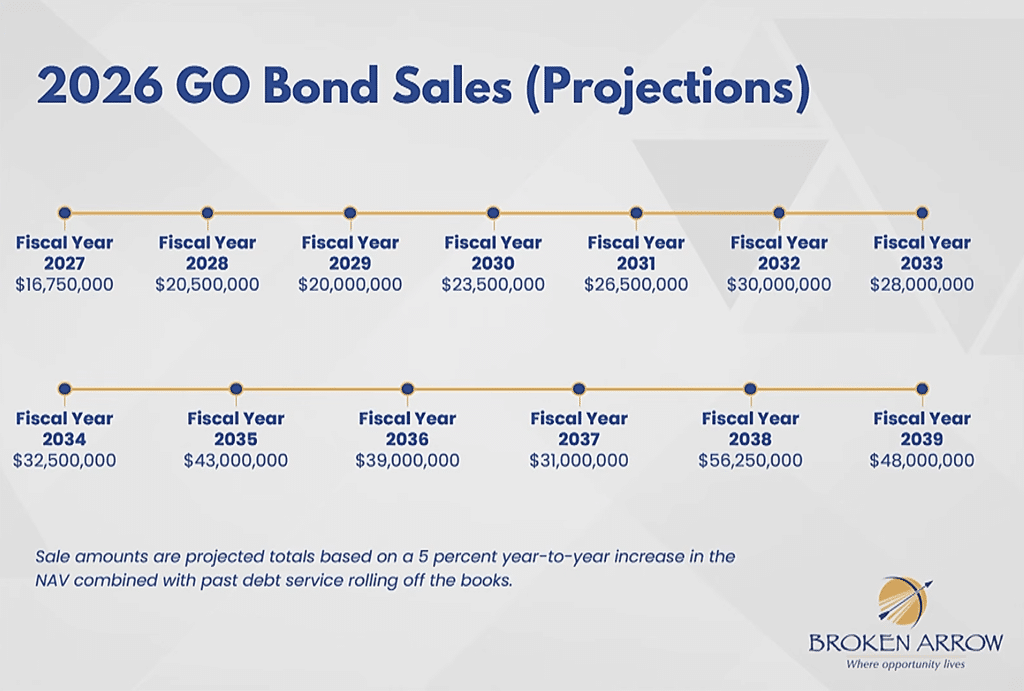
The city projects to have $16.7 million dollars available for fiscal year 2027 through bond sales to complete projects, and $20 million to $28 million each year through 2033.
The amounts are projected to increase to $32.5 million in 2034 and $48 million in 2039 as debt from previous bond projects begins to drop off, Schwab said.
“This year is the only year we can talk about with any real factual matters. Everything else after this is a projection,” said Charlie Bright, the city’s director of Engineering and Construction. “But our priorities are based off what we’ve heard from the governing body, the public at large, and our city leadership.”
Bright said the city tried to balance the need to get larger projects in the design and land acquisition phase while also adding amenities the public would enjoy. He also noted the priorities could change in a few years if there is turnover on the City Council.
In December the first sale under the 2026 bond election will take place. The city sought bids for the bond sale and Robert W. Baird’s bid was a 4.1337%. Four bids were submitted for a the $2 million bond sale from Series 2026C, which will fund a $1.1 million stormwater project and $844,000 in drainage projects. Robert W. Baird had the lowest bid at 4.2155%.
“With every project, we try to meet the mill levy goals and targets,” said Jon Wolff, President and Chief Commercial Officer of Municipal Financial Services, Inc. in Edmond. “This was a smaller issue set out over 20 years. It will have smaller principal payments, and it’s a little tougher to sell.”
The $16.7 million in bond projects to be started next year include:
CONSTRUCTION: South Main Street improvements, improvements to the intersections of 91st Street and 1st Place; Central Park Community Center Renovation and regional detention pond for the North Elm Economic Development Area (NEEDA).
DESIGN: Omaha Street widening from Aspen Avenue to Elm Place; pickleball and volleyball courts at Nienhuis Park, Rose District Plaza and an addition for The Museum Broken Arrow.
LAND ACQUISITION/ROW/UTILITY RELOCATION: Omaha Street widening, New Orleans Street widening (Garnett to Olive), the intersection of Tucson Street and Olive Avenue; Military History Museum; new dog park and a vehicle storage building.
In 2028, construction could potentially begin on the Nienhuis sport courts, Country Aire Splash Pad, Rose District Plaza and improvements to Hillside Drive and 20th Street. Design would begin on the vehicle storage building and senior center addition, and land acquisition/ROW/utility relocation could begin for Fire Station 1, senior center addition and Rose District plaza.
Allowances could also be made for residential street rehabilitation, trail system improvements and fire truck and ambulance acquisition in future years.
In 2029, the city projects construction of Tucson Street from Olive to Aspen and improvements to the Tucson and Olive intersection.
At current projections, 2031 could be a big construction year, with improvements to the intersection of Houston Street and Evans Road; construction of Fire Station 1, Jackson Park improvements; the Veterans Center Expansion, and the new South Broken Arrow Library.
Schwab said the city is grateful for the nearly 70% percent support from voters for bonding projects, because sales tax revenue won’t make projects happen for a city of Broken Arrow’s size.
“I think the most important thing is it doesn’t work without the voters. The voters have been such a strong supporter of Broken Arrow getting the capital improvements done, and without them, it wouldn’t happen,” Schwab said. “Bonds are really the only mechanism that we can do.”
How Millages Work
So how does Broken Arrow’s millage rate for city operations compare to neighboring cities?
A mill is a property tax unit equal to 1/10th of a cent, meaning taxpayers are charged $1 of tax for every $1,000 of assessed property value. In Tulsa County, for a home with a value of $250,000 that’s in the city of Broken Arrow and Broken Arrow Public Schools limits, that comes out to $3,415 in property taxes.
For city operations these figures were provided by the city’s Finance Director, Cindy Arnold:
Tulsa — 21.92 mills
Bixby — 20.25
Broken Arrow — 16.48
Oklahoma City — 15.16
Moore — 14.98
Sand Springs — 14.90
Sapulpa — 14.54
Bartlesville — 11.90
Norman — 10.42
Jenks — 5.99
“We’re not the highest, but we’re not the lowest,” Arnold said. “But I think we do a great job with our mills. We do a lot of work, and there’s always construction going on.”
The bulk of that goes to taxing entities such as public schools and colleges, city and county government, library system and the health department. Broken Arrow Public Schools gets 69.44 mills; the Union Public Schools portion in Broken Arrow receives 72.08 mills, and Bixby is 74.16 mills.



Leave a Reply