By John Dobberstein, Editor
Oklahoma Attorney General Gentner Drummond has asked President Trump and U.S. Attorney General Todd Blanche to halt the U.S. Department of Justice’s investigation into Broken Arrow’s denial of a rezoning request for a mosque in the city.
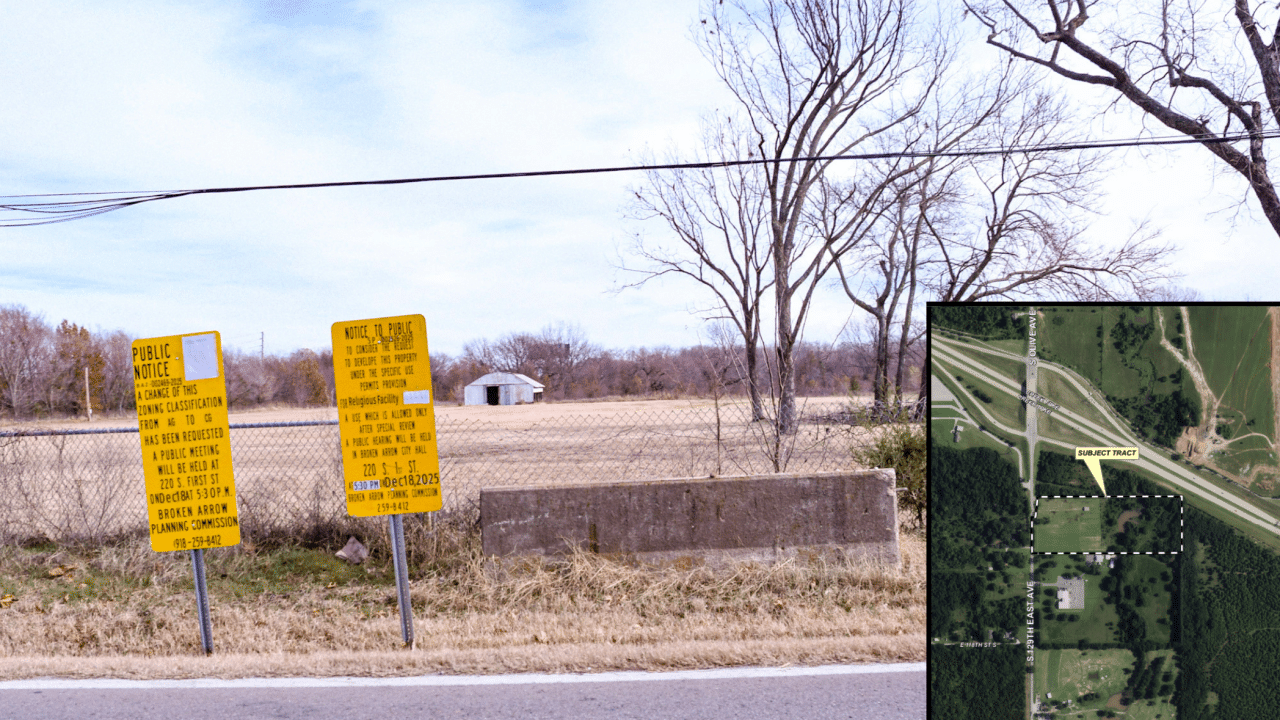
The DOJ announced this week it was conducting a preliminary investigation of the city’s denial of a rezoning request by the Islamic Society of Tulsa to build a commercial center and mosque on Olive Avenue just south of the Creek Turnpike.
The DOJ is investigating the city’s zoning practices under the Religious Land Use and Institutionalized Persons Act (RLUIPA). But Gentner said the probe by the DOJ’s Civil Rights Division is, “an example of federal overreach and an unwarranted intrusion into local government.”
“Land-use decisions such as this belong to state and locally elected officials who are accountable to the people they serve, not unelected bureaucrats in Washington,” Drummond said in a letter to Trump and Blanche. “Oklahoma cities should not be subjected to sweeping federal investigations based on a single zoning decision when the DOJ itself acknowledges it has made no determination that federal law was violated.”
Drummond’s letter argues the investigation exceeds the DOJ’s authority by demanding years of municipal records, including communications involving private citizens who participated in the local zoning process. He warned that such demands threaten First Amendment rights by, “chilling citizens’ willingness to speak, assemble and participate in local government.”
Drummond’s letter states the DOJ’s “indefensible” requests include more than 5 years of records, including the complete application file for every place of assembly the City has considered since 2021. The DOJ also asked for emails, text messages, social media posts and hearing testimony of private citizens, along with all communications concerning a January 2026 gathering of residents at a private event center.
“The First Amendment does not permit federal surveillance of Americans who participate in local government. The chilling effect of these demands is neither incidental nor acceptable,” Drummond’s letter said.
Drummond demanded the DOJ withdraw or suspend its investigation pending review by Senate-confirmed leadership, require senior-level approval for any further investigative steps, withdraw demands targeting the speech and associational activities of private citizens and coordinate with his office, “before taking further action against any Oklahoma municipality.”
Drummond said he supported the City of Broken Arrow and pledged his office will assist the city “by every lawful means” in responding to the federal investigation.
The DOJ informed the city of Broken Arrow recently that the federal agency plans to investigate the city’s zoning and land-use practices after the City Council voted to deny a rezoning request for a mosque.
In a letter to Mayor Debra Wimpee and City Attorney Trevor Dennis, the DOJ said it probe the city’s practices in connection with RLUIPA, which was passed in 2000. The act prohibits application of a land use regulation that imposes a substantial burden on religious exercise absent a compelling justification pursued in the least restrictive means.
The Islamic Society of Tulsa said on Facebook Thursday the organization was “disappointed” in Drummond’s position, noting that RLUIPA is a federal law, “and it is the federal government’s job to enforce it when they have a reasonable suspicion that a local government might have ignored it. We welcome the DOJ’s investigation and urge AG Drummond to let the investigation proceed and let the results of the investigation speak for themselves.
“Our hope remains simple: to build a house of worship that will help ease the burden on our only mosque in Tulsa, and where our community members of Broken Arrow can gather, and strengthen our relationships with all of our neighbors along the way.”
A question-and-answer document on the DOJ’s website says RLUIPA applies counties, municipalities, villages, towns, cities, city councils, planning boards, zoning boards and zoning appeals boards. Religious assemblies and institutions are not exempt from local zoning laws and must apply for the same permits, follow the same requirements, and go through the same land use processes as other land users.
When there is a conflict between RLUIPA and the zoning code or how it is applied, the DOJ says in its fact sheet that RLUIPA, as a federal civil rights law, takes precedence. They cite Holy Ghost Revival Ministries vs. City of Marysville, where a judge ruled zoning laws that conflict with RLUIPA must yield under the Supremacy Clause.
According to the DOJ’s 2020 report on RLUIPA cases, the U.S. Supreme Court has never ruled on a land-use case involving RLUIPA, although federal courts of appeals and district courts have made numerous rulings.
Drummond himself announced early this year, just days before the zoning hearing, that his office was investigating the mosque as to whether the proposed project, “complies with Oklahoma law and applicable federal statutes.”
He was also to investigate funding sources for the project, the land for which is owned by the North American Islamic Trust — an organization that controls the deeds to more than 300 mosques and religious centers across the U.S.
Drummond said NAIT, “reportedly has ties to the radical Muslim Brotherhood,” a claim that has been stated numerous times since the organization was named an unindicted co-conspirator in the Holy Land Foundation prosecutions in 2008.
When asked Thursday if the Attorney General’s Office investigation was still active, Communications Director Carrie Burkhart said, “our position remains unchanged. We cannot provide any additional information regarding the ongoing investigation at this time.”



John Henderson says
Citizens of Broken Arrow do not want a mosque in the city limits of our town. Thousands of our residences are very, very worried about the history of the Islamic faith and their connections to violence and community problems that come along with beliefs.
Barbara Burnett says
As a long time Broken Arrow resident, I totally agree with John Henderson.