By John Dobberstein, Editor
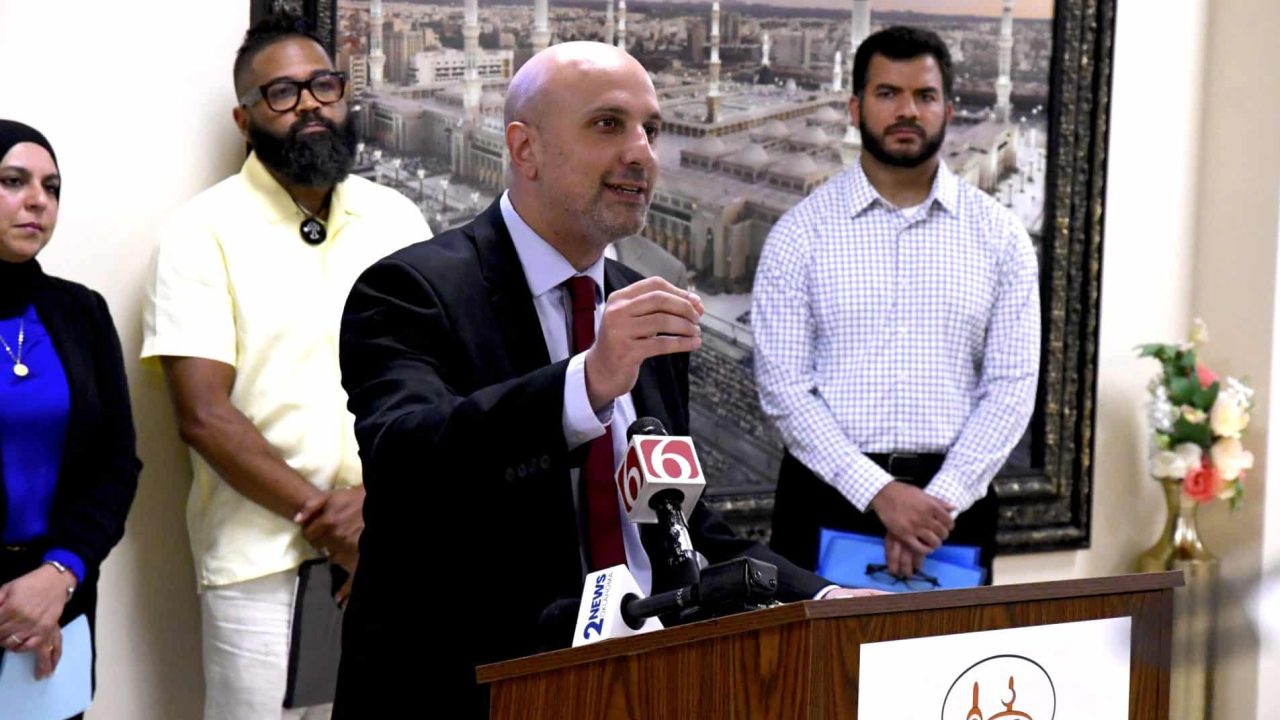
TULSA — The Islamic Society of Tulsa and a prominent Muslim civil rights organization alleged in a federal lawsuit filed Monday that the Broken Arrow City Council’s decision to deny a rezoning request for a mosque violated federal law.
The 63-page suit filed in U.S. District Court in Tulsa by IST and the Council on American-Islamic Relations (CAIR) alleges the Broken Arrow City Council’s denial of IST’s rezoning request, in context with other land-use decisions made last year, violated the Religious Land Use and Institutionalized Persons Act (RLUIPA).
In January, the City Council voted 4-1 to deny IST’s request to rezone 15 acres from agricultural and floodplain to “commercial heavy” and floodplain for the mosque, citing numerous concerns over infrastructure. More than 1,000 people flooded the campus at Northeastern State University-Broken Arrow for the hearing, many of them expressing concerns about the project or disapproving of Muslim culture.
IST bought the property in 2014 for approximately $625,000. IST’s Tulsa mosque is over-capacity and some worshippers are unable to attend Friday services because they cannot find a parking space, IST officials said. Many Broken Arrow Muslim residents must travel outside Broken Arrow to participate in congregational prayer, religious education and other religious programming.
Lawyers for IST said the organization wants to establish a mosque and Islamic community center in Broken Arrow, “so that IST and its members can gather to worship where many of them live, work, raise families and serve the community.”
In the lawsuit, attorneys for CAIR and IST shared several examples of nearby projects allowed to proceed in spite of infrastructure concerns, including the Aspen Creek Villas and Harvest Church’s expansion. But, IST alleged, the same objections were used by the city for “immediate and complete denial,” of the zoning and permit requests.
According to the filing, engineer Nicole Watts, speaking for IST, stated during the January zoning hearing that traffic volumes on Olive Avenue were well below the project’s anticipated weekday peak use and peak traffic would happen during off-peak traffic hours.
Watts explained, the lawsuit states, that IST’s conceptual site plan included a right-of-way dedication for a future access road, and IST would continue working with city staff to address any remaining traffic issues. Watts also stated, the lawsuit said, that Broken Arrow had approved similar places of assembly in commercially zoned areas, “making IST’s applications consistent with prior City decisions.”
Although the City Council questioned parking capacity, Watts explained the figures provided by IST were “preliminary” and that the parking plan had been revised to comply with the zoning ordinance. A detention pond designed to meet state discharge requirements on the site plan should have addressed flooding concerns, she said.
The city’s Community Development Director, Rocky Henkel, also said the rezoning request was consistent with the city’s Comprehensive Plan and surrounding land uses and that a place of assembly is permitted in the district with a conditional use permit.
The lawsuit alleges the city violated RLUIPA in several ways, including by treating IST’s proposal less favorably than secular developments nearby and “intentionally” discriminating against IST based on religion and religious denomination.
The City Council’s decision, the lawsuit said, imposes substantially more than a mere inconvenience on IST by preventing the project from moving forward and did not represent least-restrictive measures to address the issues as RLUIPA requires.
The lawsuit also alleged the City of Broken Arrow and City Council violated the Fourth and Fourteenth Amendments by imposing a substantial burden on the free exercise of religion by IST and applying zoning laws, “in a manner that preferred Christian religious institutions over IST, an Islamic religious institution.”
“No compelling governmental interest permits state or local officials to discriminate against an applicant because it is Muslim or because it seeks to construct a mosque,” the lawsuit said. “Even assuming that traffic, flooding, parking, wastewater, infrastructure and land use compatibility constitute compelling governmental interests in the abstract, the outright denial of both applications was not narrowly tailored to address those interests.
“Technical concerns could have been addressed through later stages of development, and the Council could have placed conditions on approval, as did the Planning Commission. (The city) did not explain why those ordinary measures were adequate for Christian and secular applicants but inadequate for IST.”
Lawyers for CAIR are asking a federal judge to require the city to approve IST’s rezoning and conditional use permit requests and work with IST on subsequent project steps. IST also asked a judge to prohibit the city from requiring IST to submit new rezoning or conditional use applications.
IST is also seeking compensatory damages, and punitive damages against the four City Councilors who voted against the rezoning — David Pickel, Mayor Debra Wimpee, Justin Green and Lisa Ford — “in an amount sufficient to punish and deter conduct undertaken that is malicious, oppressive, or shows reckless or callous indifference to IST’s federally protected rights.”
City Councilor Johnnie Parks, who voted to approve the rezoning and permit, was not named in the federal lawsuit.
The Broken Arrow City Council and city of Broken Arrow, which has yet to comment publicly on the lawsuit, is expected to discuss the Department of Justice’s parallel investigation of the city’s zoning laws and land-use practices in an executive session tonight. A motion to hire an attorney to represent the city in the DOJ investigation is on the agenda as well.
It’s possible some kind of settlement could occur with the development, IST officials said, but for now they are pursuing legal action.
“While we are disappointed that the City’s decision makes it necessary for us to take this action, we remain hopeful that a resolution can be found quickly which will allow us to construct our facility and serve the Broken Arrow community just as we have served our Tulsa neighbors for years,” said Syed Newaz, Board Chairman for IST.
“Our vision has never been about changing Broken Arrow; it has been about serving families who already live here, providing a place to worship, educating our children, supporting local businesses, and contributing to the city alongside our neighbors.”
“City officials made a serious mistake here, but it isn’t too late for Broken Arrow to change course,” said Gadeir Abbas, deputy litigation director at CAIR Legal Defense Fund. “Rather than embroil Broken Arrow in litigation it is sure to lose, we urge city officials to come to the table and settle this through dialogue and good-faith negotiations.”




Leave a Reply