
By John Dobberstein, Editor
Lawyers representing the Islamic Society of Tulsa in its federal lawsuit against the city of Broken Arrow and City Council said “unlawful animus’ was behind the Council’s denial of a rezoning request and permit for a mosque.
The city filed a motion last month in U.S. District Court asking a judge to dismiss IST’s lawsuit over the denial. The city’s lawyers argued the City Council members are protected by the same legislative immunity that applies to state or federal lawmakers, as well as “quasi-judicial immunity.”
Either power protects them from the lawsuit and that includes zoning and land-use decisions, the city’s lawyers said.
But IST’s lawyers responded Friday, arguing legislative immunity is unavailable to City Council members because those powers only protect them, “when they are acting in a legislative capacity to pass laws that generally apply in the future,” adding that the city’s denial was not “general” in this case.
“It was instead about a single applicant’s use of a specific piece of land. Legislative immunity does not insulate from judicial scrutiny the kind of case-by-case decision making the (defendants) used to deny IST permission to use its land for an Islamic purpose.
“And without immunity, this court must scrutinize the (defendants’) actions in keeping Broken Arrow — a town blessed with many houses of worship—free of any mosques.”
IST’s lawyers also assert the city’s decisions on conditional use permit and the rezoning application were administrative, rather than legislative.
The lawsuit filed on behalf of IST by the Council on American-Islamic Relations (CAIR) alleged the city’s denial — in context with other land-use decisions made last year — violated the Religious Land Use and Institutionalized Persons Act (RLUIPA). The city of Broken Arrow, City Council member Lisa Ford, David Pickel and Justin Green and Mayor Debra Wimpee were named as defendants.
IST’s lawyers laid the foundation to their Friday filing by pointing to emails from Mayor Debra Wimpee and City Councilwoman Lisa Ford expressing concerns about the motivations or alleged violent tendencies of Muslims who have moved into other communities. The emails were written before the City Council rendered their decision.
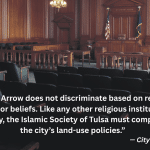
However, the City Council members named in the lawsuit have repeatedly said their reasons for voting against the zoning and permit were due to infrastructure concerns at the site, including lack of sewer service, only one entrance and exit being available, and Olive Avenue being a two-lane street that feeds onto the Creek Turnpike.
Is it ‘substantial burden’?
Meanwhile, a pending U.S. Supreme Court case could also have an impact on the deliberations.
Fox News reported recently that SCOTUS judges agreed to hear a case involving a Kentucky church’s fight to build a prayer grotto on its property. The case involves a dispute over what constitutes a “substantial burden” on religious exercise under federal land-use law.
IST’s lawsuit alleges that by imposing and implementing its zoning ordinance through the final denial of rezoning and a permit, the city, “imposed a substantial burden on IST’s religious exercise.” But the city’s lawyers argue IST’s legal team hasn’t met the bar.
“The denial of a specific land-use application under the circumstances here — where the subject property lacks any particular religious significance of its own, and where there is no allegation regarding the unavailability of other sites
or the prospects of a subsequent and different application regarding the subject property—cannot clear the bar for substantial burden claims,” the city’s motion said.
Ryan Gardner, senior counsel at First Liberty Institute, which represents the Missionaries of St. John the Baptist, told Fox News Digital the implications stretch far beyond the proposed Catholic shrine in Park Hills, Ky.
The Supreme Court agreed to hear a question from the church whether prohibiting a religious institution from building a religious structure on its own property constitutes a “substantial burden” on religious exercise under the law.
Ryan Gardner, senior counsel at First Liberty Institute, which represents the Missionaries of St. John the Baptist, told Fox that lower courts have developed different approaches to Religious Land Use and Institutionalized Persons Act (RLUIPA) since Congress enacted it in 2000.
This has left religious organizations with different levels of protection depending on where a dispute arises.
Garner told Fox the Supreme Court has an opportunity in the Kentucky case to establish a clearer standard nationwide.
The missionaries similarly argued in their Supreme Court petition, according to Fox, that federal and state courts are divided over how to determine whether a land-use restriction creates a “substantial burden” under RLUIPA.
The Frederics disputed that characterization in their opposition brief, arguing appellate courts generally consider similar factors and that differing outcomes can reflect differing facts. The Frederics also argued that the Missionaries failed to show that alternative locations for the grotto were unavailable.
The case also puts two constitutionally significant areas of law alongside one another — religious exercise and the authority of local governments to regulate property use.
While Gardner acknowledged that zoning serves a legitimate role in how local governments organize, he argued those same regulations remain subject to federal-level protections for religious exercise. That question, he said, “reaches well beyond one prayer grotto in Kentucky.”
The SCOTUS ruling could affect disputes involving churches, synagogues, ministries and other religious organizations seeking to use their properties for worship or religious activities, according to Gardner. He warned that an overly narrow interpretation of the federal law could have “dire consequences” for religious land use around the country.



Leave a Reply