By John Dobberstein, Editor
The city of Broken Arrow filed a motion Friday asking a judge to dismiss a federal lawsuit over the denial of a mosque development, claiming City Council members who voted against it have “legislative immunity.”
The Islamic Society of Tulsa and Council on American-Islamic Relations (CAIR) filed a lawsuit in August claiming religious discrimination after the City Council voted 4-1 to deny a rezoning request and conditional use permit for the project, which had previously been approved by city city’s Planning Commission.
The 63-page suit filed in U.S. District Court in Tulsa by IST and CAIR alleged the Broken Arrow City Council’s denial — in context with other land-use decisions made last year — violated the Religious Land Use and Institutionalized Persons Act (RLUIPA). The city of Broken Arrow, City Council member Lisa Ford, David Pickel and Justin Greene and Mayor Debra Wimpee were named as defendants.
But the city’s dismissal motion argues the City Council is protected by the same legislative immunity that applies to state or federal lawmakers, as well as “quasi-judicial immunity.” Either protects them from the lawsuit and that includes zoning and land-use decisions, lawyers said.
“Under Oklahoma law, members of a city council or other municipal governing body are charged with responsibility for determining how the land within their jurisdiction may be used,” the city’s lawyers wrote.
“These decisions require the exercise of each individual member’s discretion and independent judgment. As such, it is essential that they be permitted to execute their duties without fear of litigation and potential personal liability.”
The Sentinel has reached out to CAIR lawyers for comment but did not receive an immediate response.
IST, which has operated a mosque in Tulsa for more than two decades, proposed a second one on 15 acres along Olive Avenue, just north of the Creek Turnpike in south Broken Arrow. They requested rezoning of the property and a conditional use permit to operate the mosque and commercial center there.
The Broken Arrow Planning Commission, after a 4-hour marathon meeting, voted 4-1 to approve the rezoning and 3-2 to approve the permit. After another nearly 5-hour public hearing with more than 40 speakers and 1,000 people descending on Northeastern State University’s campus, the City Council voted 4-1 to deny the rezoning and permit.
The stated basis for the decision was over infrastructure concerns, as there is no sewer service, Olive Avenue is only a two-lane road, and the property has only one entrance and exit.
IST claims, according to the city’s lawyers, that the project was denied out of, “animosity towards Muslims and an irrational fear of Islam.” But the city argues IST did not provide sufficient facts to claim discrimination.
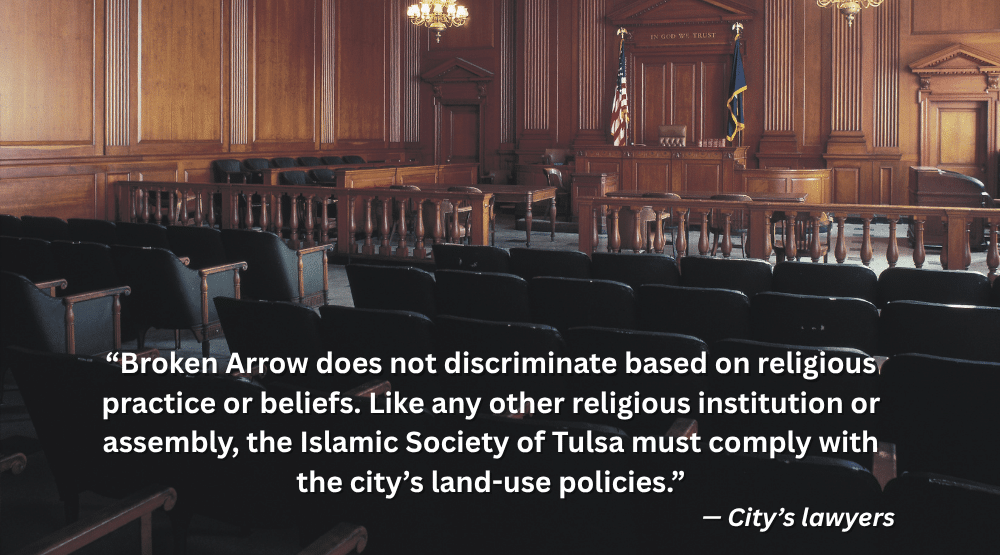
“Broken Arrow does not discriminate based on religious practice or beliefs,” lawyers wrote in the motion. “Like any other religious institution or assembly, IST must comply with the city’s land-use policies, which are facially neutral between religious and non-religious uses, neutral among religious denominations and administered in a way that does not discriminate or substantially burden anyone’s free exercise of religion.”
The city also argues IST did not provide adequate proof that IST’s religious exercises were burdened, or that the organization was treated on less-than-equal terms with a nonreligious assembly or institution.
Separately, the U.S. Department of Justice announced in July it was probing Broken Arrow’s zoning and land use regulations due to the city’s decision. The results of the investigation have not yet been released.
Shortly after, Oklahoma Attorney General Gentner Drummond asked President Trump and U.S. Attorney General Todd Blanche to halt the DOJ investigation. A spokesperson for Drummond said recently the request was acknowledged and discussions were ongoing.




Leave a Reply